


Page 158 - (DK Eyewitness) Travel Guide - Sicily
P. 158
156 SICIL Y AREA B Y AREA
P Corso Umberto I
The many interesting churches
and buildings along the town’s
main street include the former
Monastero delle Benedettine
(a convent for Benedictine nuns
now used as a courthouse), the
19th-century Teatro Garibaldi,
the 18th-century Palazzo
Tedeschi, Santa Maria del
Soccorso and Palazzo Manenti,
whose corbels are decorated
with figures of all kinds.
R San Pietro
Also on Corso Umberto I is a flight
of Baroque monumental steps,
flanked by statues of the Apostles,
which leads to the entrance of
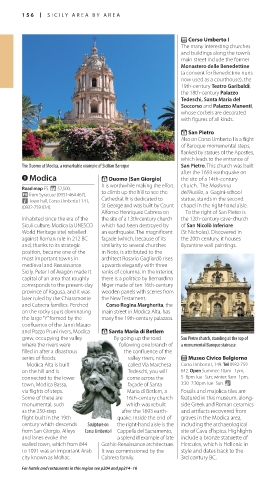
The Duomo at Modica, a remarkable example of Sicilian Baroque San Pietro. This church was built
after the 1693 earthquake on
8 Modica R Duomo (San Giorgio) the site of a 14th-century
It is worthwhile making the effort church. The Madonna
Road map E5. * 52,500.
V from Syracuse (0931-464 467). to climb up the hill to see the dell’Ausilio, a Gagini-school
n Town hall, Corso Umberto I 141, Cathedral. It is dedica ted to statue, stands in the second
(0932-759 634). St George and was built by Count chapel in the right-hand aisle.
Alfonso Henriquez Cabrera on To the right of San Pietro is
Inhabited since the era of the the site of a 13th-century church the 12th-century cave-church
Siculi culture, Modica (a UNESCO which had been destroyed by of San Nicolò Inferiore
World Heritage site) rebelled an earthquake. The magnificent (St Nicholas). Discovered in
against Roman rule in 212 BC façade (which, because of its the 20th century, it houses
and, thanks to its strategic similarity to several churches Byzantine wall paintings.
position, became one of the in Noto, is attributed to the
most important towns in architect Rosario Gagliardi) rises
medieval and Renaissance upwards elegantly with three
Sicily. Peter I of Aragón made it ranks of columns. In the interior,
capital of an area that roughly there is a polittico by Bernardino
corresponds to the present-day Niger made of ten 16th-century
province of Ragusa, and it was wooden panels with scenes from
later ruled by the Chiaramonte the New Testament.
and Cabrera families. Perched Corso Regina Margherita, the
on the rocky spurs dominating main street in Modica Alta, has
the large “Y” formed by the many fine 19th-century palazzos.
confluence of the Janni Mauro
and Pozzo Pruni rivers, Modica R Santa Maria di Betlem
grew, occupying the valley By going up the road San Pietro church, standing at the top of
where the rivers were following one branch of a monumental Baroque staircase
filled in after a disastrous the confluence of the
series of floods. valley rivers, now E Museo Civico Belgiorno
Modica Alta is built called Via Marchesa Corso Umberto I, 149. Tel 0932-759
on the hill and is Tedeschi, you will 642. Open Summer: 10am– 1pm,
connected to the lower come across the 5–8pm Tue–Sun; winter: 9am–1pm,
town, Modica Bassa, façade of Santa 3:30–7:30pm Tue–Sun. &
via flights of steps. Maria di Betlem, a Fossils and majolica tiles are
Some of these are 16th-century church featured in this museum, along-
monumental, such which was rebuilt side Greek and Roman ceramics
as the 250-step after the 1693 earth- and artifacts recovered from
flight built in the 19th quake. Inside the end of graves in the Modica area,
century which descends Sculpture on the right-hand aisle is the including the archaeological
from San Giorgio. Alleys Corso Umberto I Cappella del Sacramento, site of Cava d’Ispica. High lights
and lanes evoke the a splendid example of late include a bronze statuette of
walled town, which from 844 Gothic-Renaissance architecture. Hercules, which is Hellenic in
to 1091 was an important Arab It was commissioned by the style and dates back to the
city known as Mohac. Cabrera family. 3rd century BC.
For hotels and restaurants in this region see p204 and pp214–16
156-157_EW_Sicily.indd 156 11/3/16 2:07 PM

