


Page 163 - (DK Eyewitness) Travel Guide - Sicily
P. 163
SOUTHERN SICIL Y 161
i Pantalica
Road map E4 (19 km/12 miles from
Ferla, 45 km/28 miles from Syracuse).
Open 7am–7pm Sat & Sun
(reservation).
Tombs, dwellings and temples
line the walls of the limestone
gorges at the confluence of the
Bottiglieria and Anapo rivers.
Pantalica was the heart of the
ancient kingdom of Hybla
which, in its heyday, used
Syracuse as its port. The city was
conquered by the Greeks when
the coastal colonies became
powerful in the 8th century BC,
and Pantalica became
important again during the
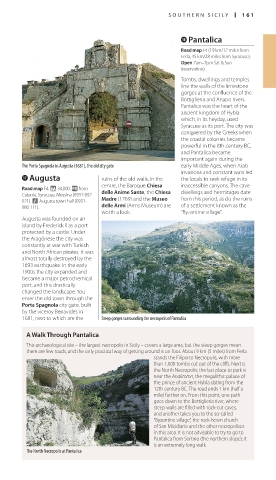
The Porta Spagnola in Augusta (1681), the old city gate early Middle Ages, when Arab
invasions and constant wars led
u Augusta ruins of the old walls. In the the locals to seek refuge in its
centre, the Baroque Chiesa inaccessible canyons. The cave
Road map F4. * 34,000. V from
Catania, Syracuse, Messina (0931-892 delle Anime Sante, the Chiesa dwellings and hermitages date
021). n Augusta town hall (0931- Madre (1769) and the Museo from this period, as do the ruins
980 111). delle Armi (Arms Museum) are of a settlement known as the
worth a look. “Byzantine village”.
Augusta was founded on an
island by Frederick II as a port
protected by a castle. Under
the Aragónese the city was
constantly at war with Turkish
and North African pirates. It was
almost totally destroyed by the
1693 earthquake. In the early
1900s the city expanded and
became a major petrochemical
port, and this drastically
changed the landscape. You
enter the old town through the
Porta Spagnola city gate, built
by the viceroy Benavides in
1681, next to which are the Steep gorges surrounding the necropolis of Pantalica
A Walk Through Pantalica
This archaeological site – the largest necropolis in Sicily – covers a large area, but the steep gorges mean
there are few roads, and the only practical way of getting around is on foot. About 9 km (5 miles) from Ferla
stands the Filiporto Necropolis, with more
than 1,000 tombs cut out of the cliffs. Next is
the North Necropolis; the last place to park is
near the Anaktoron, the megalithic palace of
the prince of ancient Hybla dating from the
12th century BC. The road ends 1 km (half a
mile) further on. From this point, one path
goes down to the Bottiglieria river, where
steep walls are filled with rock-cut caves,
and another takes you to the so-called
“Byzantine village”, the rock-hewn church
of San Micidiario and the other necropolises
in this area. It is not advisable to try to go to
Pantalica from Sortino (the northern slope); it
is an extremely long walk.
The North Necropolis at Pantalica
160-161_EW_Sicily.indd 161 11/3/16 2:10 PM

