


Page 21 - (DK Eyewitness) Travel Guide - Sicily
P. 21
INTRODUCING SICIL Y 19
A PORTRAIT
OF SICILY
Sicilian shores are washed by three different seas, and this is reflected in the
ancient name for Sicily: “Trinacria”, the three-cornered island. Each part of the
island has its own history and own character, creating a varied and complex
whole. Yet over the centuries Sicily has acquired a sense of unity and identity.
Sicily’s history can be traced back more more clipped accent of Catania and
than 3,000 years, during which time it Syracuse. Accent differences are still
has been dominated by many different noticeable, though they have moderated
peoples, from the Greeks to the Romans, to some degree over the centuries.
Byzantines and Arabs, and from the There are east–west economic and social
Normans to the Spanish. Each suc differences as well as linguistic ones.
ceeding culture left its mark on the However, the island’s long, eventful and
island and may perhaps help to explain tortuous history has not been the only
aspects of the modern Sicilian character. factor influencing its life and inhabitants.
This diverse inheritance manifests itself Few places have been so affected by
in a curious combination of dignified their climate and topography: in Sicily
reserve and exuberant hospitality. the temperature is 30°C (86°F) for four
The western side of the island, which months of the year, and when the sun
is centred upon Palermo, is historically disappears, destructive torrential rains
considered to be of PunicArab influence. can take its place. The Sicilian climate
The eastern side was once the centre of is one of extremes and can sometimes
Magna Graecia, with its coastal towns even be cruel; it has shaped the island’s
of Messina, Catania and Syracuse. This extraordinary landscape which, as the
difference may be discerned in the Sicilian novelist Tomasi di Lampedusa
speech of local people: the “singsong” noted, includes the hell of Randazzo
dialect of Palermo as opposed to the (the closest town to the craters of
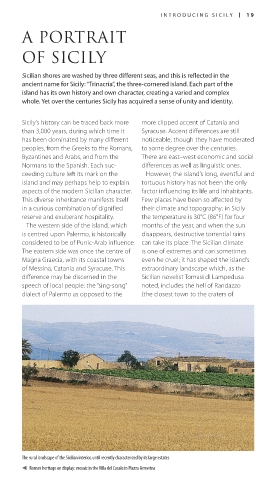
The rural landscape of the Sicilian interior, until recently characterized by its large estates
Roman heritage on display: mosaic in the Villa del Casale in Piazza Armerina
018-021_EW_Sicily.indd 19 11/3/16 2:06 PM

