


Page 26 - (DK Eyewitness) Travel Guide - Sicily
P. 26
24 INTRODUCING SICIL Y
Architecture in Sicily
Three periods have shaped much of Sicily’s
architecture. The first was the time of Greek
occupation, when monumental works
(especially temples and theatres) were built.
Aesthetically they were often equal to, and in
some cases superior to, those in Greece itself.
The medieval period witnessed the fusion of
the Byzantine, Arab and Norman styles in such
buildings as the Cathedral at Monreale near Locator Map
Palermo. Last came the flowering of Baroque Classical Architecture
architecture in the 17th–18th centuries. The Medieval Architecture
style was so individual that it became known Baroque Architecture
as Sicilian Baroque.
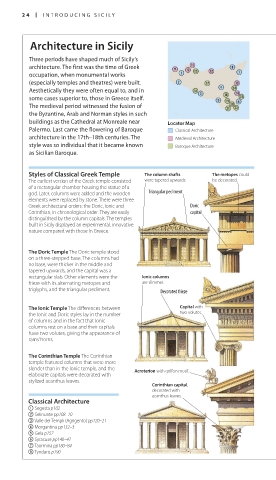
Styles of Classical Greek Temple The column shafts The metopes could
The earliest version of the Greek temple consisted were tapered upwards. be decorated.
of a rectangular chamber housing the statue of a
god. Later, columns were added and the wooden Triangular pediment
elements were replaced by stone. There were three
Greek architectural orders: the Doric, Ionic and Doric
Corinthian, in chronological order. They are easily capital
distinguished by the column capitals. The temples
built in Sicily displayed an experimental, innovative
nature compared with those in Greece.
The Doric Temple The Doric temple stood
on a three-stepped base. The columns had
no base, were thicker in the middle and
tapered upwards, and the capital was a
rectangular slab. Other elements were the Ionic columns
frieze with its alternating metopes and are slimmer.
triglyphs, and the triangular pediment. Decorated frieze
The Ionic Temple The differences between Capital with
the Ionic and Doric styles lay in the number two volutes.
of columns and in the fact that Ionic
columns rest on a base and their capitals
have two volutes, giving the appearance of
rams’ horns.
The Corinthian Temple The Corinthian
temple featured columns that were more
slender than in the Ionic temple, and the Acroterion with griffon motif.
elaborate capitals were decorated with
stylized acanthus leaves.
Corinthian capital,
decorated with
acanthus leaves.
Classical Architecture
1 Segesta p102
2 Selinunte pp108–10
3 Valle dei Templi (Agrigento) pp120–21
4 Morgantina pp132–3
5 Gela p157
6 Syracuse pp140–47
7 Taormina pp180–84
8 Tyndaris p190
SC_024-025_Feat4.indd 24 17/11/2014 15:50
Eyewitness Travel LAYERS PRINTED:
Feature template “UK” LAYER
(SourceReport v1.6)
Date 27th March 2014
Size 125mm x 217mm

