


Page 36 - (DK Eyewitness) Travel Guide - Sicily
P. 36
34 INTRODUCING SICIL Y
Prehistoric and Ancient Sicily
When Greek colonists arrived in Sicily in the 8th century
BC, in the east they found the Sicels – a Mediterranean
popu lation that had been there since 7000 BC – and
the Phoenicians to the west. The former were soon
assimilated, while the latter were ousted after the
Battle of Himera (480 BC). This marked the beginning
of Greek supre macy and the height of the Magna Locator Map
Graecia civilization, which ended in 212 BC with the Greek Colonization of the
Mediterranean
Roman conquest of Syracuse. Roman Sicily saw the
rise of large feudal estates and the imposition of taxes.
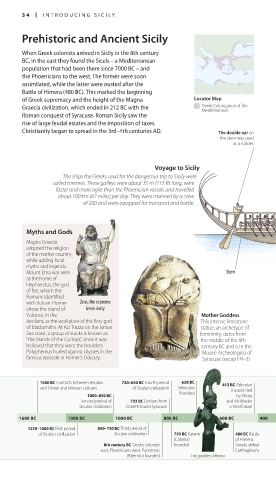
Christianity began to spread in the 3rd–4th centuries AD. The double oar on
the stern was used
as a rudder.
Voyage to Sicily
The ships the Greeks used for the dangerous trip to Sicily were
called triremes. These galleys were about 35 m (115 ft) long, were
faster and more agile than the Phoenician vessels and travelled
about 100 km (62 miles) per day. They were manned by a crew
of 200 and were equipped for transport and battle.
Myths and Gods
Magna Graecia
adopted the religion
of the mother country
while adding local
myths and legends.
Mount Etna was seen Stern
as the home of
Hephaestus, the god
of fire, whom the
Romans identified
with Vulcan. Homer Zeus, the supreme
chose the island of Greek deity
Vulcano, in the Mother Goddess
Aeolians, as the workplace of this fiery god This intense limestone
of blacksmiths. At Aci Trezza on the Ionian statue, an archetype of
Sea coast, a group of stacks is known as femininity, dates from
“the islands of the Cyclops”, since it was the middle of the 6th
believed that they were the boulders century BC and is in the
Polyphemus hurled against Ulysses in the Museo Archeologico of
famous episode in Homer’s Odyssey. Syracuse (see pp144–5).
1500 BC Contacts between Aeolian 730–650 BC Fourth period 628 BC 413 BC Athenian
and Cretan and Minoan cultures of Siculan civilization Selinunte invasion led
founded
1000–850 BC by Nicias
Second period of 733 BC Dorians from and Alcibiades
Siculan civilization Corinth found Syracuse a total failure
1600 BC 1300 BC 1000 BC 800 BC 600 BC 400
1270–1000 BC First period 850–730 BC Third period of
of Siculan civilization Siculan civilization 729 BC Katane 480 BC Battle
(Catania) of Himera:
8th century BC Greeks colonize founded Greeks defeat
east, Phoenicians west. Panormos Carthaginians
(Palermo) founded The goddess Athena
034-035_EW_Sicily.indd 34 04/11/2016 10:54

