


Page 34 - (DK Eyewitness) Travel Guide - Sicily
P. 34
32 INTRODUCING SICIL Y
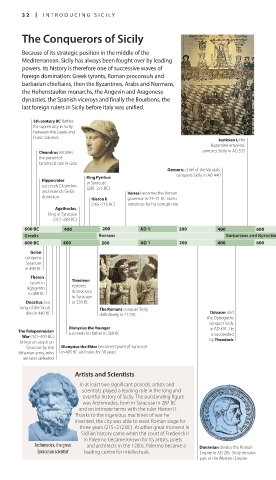
The Conquerors of Sicily
Because of its strategic position in the middle of the
Mediterranean, Sicily has always been fought over by leading
powers. Its history is therefore one of successive waves of
foreign domination: Greek tyrants, Roman proconsuls and
barbarian chieftains, then the Byzantines, Arabs and Normans,
the Hohenstaufen monarchs, the Angevin and Aragonese
dynasties, the Spanish viceroys and finally the Bourbons, the
last foreign rulers in Sicily before Italy was unified.
5th century BC Battles
for supremacy in Sicily
between the Greek and
Punic colonies
Justinian I, the
Byzantine emperor,
Cleandros initiates annexes Sicily in AD 535
the period of
tyrannical rule in Gela
Genseric, chief of the Vandals,
conquers Sicily in AD 440
King Pyrrhus
Hippocrates at Syracuse
succeeds Clean dros (280–275 BC)
and extends Gela’s Verres becomes the Roman
dominion Hieron II governor in 73–71 BC and is
(265–215 BC) notorious for his corrupt rule
Agathocles,
king of Syracuse
(317–289 BC)
600 BC 400 200 AD 1 200 400 600
Greeks Romans Barbarians and Byzantines
600 BC 400 200 AD 1 200 400 600
Gelon
conquers
Syracuse
in 490 BC
Theron,
tyrant in Timoleon
Agrigento restores
in 488 BC democracy
in Syracuse
Ducetius, last in 339 BC
king of the Siculi, The Romans conquer Sicily
dies in 440 BC definitively in 212 BC Odoacer and
the Ostrogoths
conquer Sicily
Dionysius the Younger in AD 491. He
The Peloponnesian succeeds his father in 368 BC
War (431–404 BC) is succeeded
brings an attack on by Theodoric
Syracuse by the Dionysius the Elder becomes tyrant of Syracuse
Athenian army, who in 405 BC and rules for 38 years
are later defeated
Artists and Scientists
In at least two significant periods, artists and
scientists played a leading role in the long and
eventful history of Sicily. The out standing figure
was Archimedes, born in Syracuse in 287 BC
and on intimate terms with the ruler Hieron II.
Thanks to the ingenious machines of war he
invented, the city was able to resist Roman siege for
three years (215–212 BC). Another great moment in
Sicilian history came when the court of Frederick II
in Palermo became known for its artists, poets
Archimedes, the great and architects in the 1200s. Palermo became a Diocletian divides the Roman
Syracusan scientist leading centre for intellectuals. Empire in AD 285. Sicily remains
part of the Western Empire
032-033_EW_Sicily.indd 32 11/3/16 2:06 PM

