


Page 62 - (DK Eyewitness) Travel Guide - Sicily
P. 62
60 P ALERMO AREA BY AREA
“the place of loud voices”, from
when vendors called out their
wares. Today, this outdoor
marketplace trades not only
in vegetables, dried fruit and
preserves, but also in other
foods such as cheese, fish and
meat, amid a tumult of colours,
sounds and smells reminiscent
of the souks in North Africa. The
Vucciria is especially impressive
in the morning, when the fish-
mongers set up shop. There are
stalls that serve sea urchin or
will do skewered giblets for you
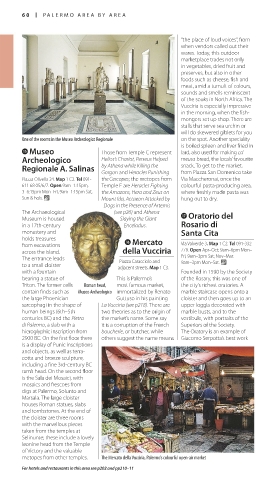
One of the rooms in the Museo Archeologico Regionale on the spot. Another speciality
is boiled spleen and liver fried in
t Museo Those from Temple C represent lard, also used for making ca’
Archeologico Helios’s Chariot, Perseus Helped meusa bread, the locals’ favourite
Regionale A. Salinas by Athena while Killing the snack. To get to the market,
from Piazza San Domenico take
Gorgon and Heracles Punishing
Piazza Olivella 24. Map 1 C2. Tel 091- the Cercopes; the metopes from Via Maccheronai, once the
611 68 05/6/7. Open 9am–1:15pm, Temple E are Heracles Fighting colourful pasta-producing area,
3–6:15pm Mon–Fri, 9am–1:15pm Sat, the Amazons, Hera and Zeus on where freshly made pasta was
Sun & hols. & Mount Ida, Actaeon Attacked by hung out to dry.
Dogs in the Presence of Artemis
The Archaeological (see p26) and Athena u Oratorio del
Museum is housed Slaying the Giant
in a 17th-century Enceladus. Rosario di
monastery and Santa Cita
holds treasures y Mercato
from excavations Via Valverde 3. Map 1 C2. Tel 091-332
across the island. della Vucciria 779. Open Apr–Oct: 9am–6pm Mon–
The entrance leads Piazza Caracciolo and Fri, 9am–3pm Sat; Nov–Mar:
9am–3pm Mon–Sat. &
to a small cloister adjacent streets. Map 1 C3.
with a fountain Founded in 1590 by the Society
bearing a statue of This is Palermo’s of the Rosary, this was one of
Triton. The former cells Roman head, most famous market, the city’s richest oratories. A
contain finds such as Museo Archeologico immortalized by Renato marble staircase opens onto a
the large Phoenician Guttuso in his painting cloister and then goes up to an
sarco phagi in the shape of La Vucciria (see p218). There are upper loggia decorated with
human beings (6th–5th two theories as to the origin of marble busts, and to the
centuries BC) and the Pietra the market’s name. Some say vestibule, with portraits of the
di Palermo, a slab with a it is a corruption of the French Superiors of the Society.
hieroglyphic inscription from boucherie, or butcher, while The Oratory is an example of
2900 BC. On the first floor there others suggest the name means Giacomo Serpotta’s best work
is a display of Punic inscriptions
and objects, as well as terra-
cotta and bronze sculpture,
incl uding a fine 3rd-century BC
ram’s head. On the second floor
is the Sala dei Mosaici, with
mosaics and frescoes from
digs at Palermo, Solunto and
Marsala. The large cloister
houses Roman statues, slabs
and tombstones. At the end of
the cloister are three rooms
with the marvellous pieces
taken from the temples at
Selinunte; these include a lovely
leonine head from the Temple
of Victory and the valuable
metopes from other temples. The Mercato della Vucciria, Palermo’s colourful open-air market
For hotels and restaurants in this area see p202 and pp210–11
060-061_EW_Sicily.indd 60 11/3/16 2:09 PM
Eyewitness Travel LAYERS PRINTED:
Catalogue template “UK” LAYER
(Source v2.6)
Date 12th July 2013
Size 125mm x 217mm

