


Page 70 - (DK Eyewitness) Travel Guide - Sicily
P. 70
68 P ALERMO AREA BY AREA
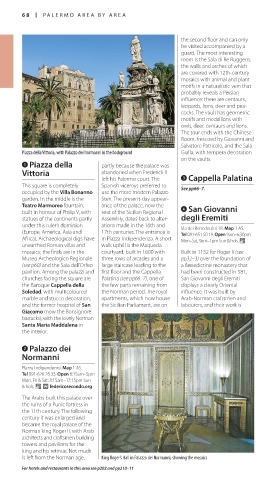
the second floor and can only
be visited accompanied by a
guard. The most interesting
room is the Sala di Re Ruggero,
the walls and arches of which
are covered with 12th-century
mosaics with animal and plant
motifs in a naturalistic vein that
probably reveals a Persian
influence: there are centaurs,
leopards, lions, deer and pea-
cocks. The vault has geometric
motifs and medallions with
owls, deer, centaurs and lions.
The tour ends with the Chinese
Room, frescoed by Giovanni and
Salvatore Patricolo, and the Sala
Piazza della Vittoria, with Palazzo dei Normanni in the background Gialla, with tempera decoration
on the vaults.
1 Piazza della partly because the palace was
Vittoria abandoned when Frederick II
left his Palermo court. The 3 Cappella Palatina
This square is completely Spanish viceroys preferred to See pp66–7.
occupied by the Villa Bonanno use the more modern Palazzo
garden. In the middle is the Steri. The present-day appear-
Teatro Marmoreo fountain, ance of the palace, now the 4 San Giovanni
built in honour of Philip V, with seat of the Sicilian Regional
statues of the continents partly Assembly, dates back to alter- degli Eremiti
under this ruler’s dominion ations made in the 16th and Via dei Benedettini 18. Map 1 A5.
(Europe, America, Asia and 17th centuries. The entrance is Tel 091-651 50 19. Open 9am–6:30pm
Africa). Archaeol ogical digs have in Piazza Indipendenza. A short Mon–Sat, 9am–1pm Sun & hols. &
unearthed Roman villas and walk uphill is the Maqueda
mosaics; the finds are in the courtyard, built in 1600 with Built in 1132 for Roger II (see
Museo Archeologico Regionale three rows of arcades and a pp32–3) over the foundation of
(see p60) and the Sala dell’Orfeo large staircase leading to the a Benedictine monastery that
pavilion. Among the palazzi and first floor and the Cappella had been constructed in 581,
churc hes facing the square are Palatina (see pp66–7), one of San Giovanni degli Eremiti
the Baroque Cappella della the few parts remaining from displays a clearly Oriental
Sole dad, with multi coloured the Norman period. The royal influence. It was built by
marble and stucco decoration, apartments, which now house Arab-Norman craftsmen and
and the former hospital of San the Sicilian Parliament, are on labourers, and their work is
Giacomo (now the Bonsignore
barracks), with the lovely Norman
Santa Maria Maddalena in
the interior.
2 Palazzo dei
Normanni
Piazza Indipendenza. Map 1 A5.
Tel 091-626 28 33. Open 8:15am–5pm
Mon, Fri & Sat; 8:15am–12:15pm Sun
& hols. & ∑ federicosecondo.org
The Arabs built this palace over
the ruins of a Punic fortress in
the 11th century. The following
century it was enlarged and
became the royal palace of the
Norman king Roger II, with Arab
architects and craftsmen building
towers and pavilions for the
king and his retinue. Not much
is left from the Norman age, King Roger’s Hall in Palazzo dei Normanni, showing the mosaics
For hotels and restaurants in this area see p202 and pp210–11
068-069_EW_Sicily.indd 68 11/3/16 2:06 PM

