


Page 71 - (DK Eyewitness) Travel Guide - Sicily
P. 71
WEST P ALERMO 69
palazzo itself was built in 1784
by Venanzio Marvuglia, who
was one of the most prolific
architects of the time. The
collection has been laid out
so that the whole building can
be admired; works are placed
both inside and outside the
museum, taking visitors
through old courtyards and
hidden corners. Works by
artists such as Pietro Consagra,
Allesandro Bazan and Carla
Accardi are part of the
permanent collection.
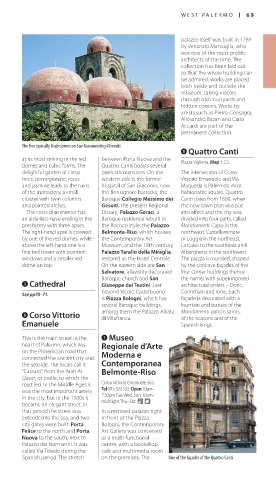
The five typically Arab domes on San Giovanni degli Eremiti
8 Quattro Canti
at its most striking in the red between Porta Nuova and the Piazza Vigliena. Map 1 C3.
domes and cubic forms. The Quattro Canti boasts several
delightful garden of citrus patrician mansions. On the The intersection of Corso
trees, pomegranate, roses western side is the former Vittorio Emanuele and Via
and jasmine leads to the ruins hospital of San Giacomo, now Maqueda is Palermo’s most
of the monastery, a small the Bonsignore barracks; the fashionable square. Quattro
cloister with twin columns Baroque Collegio Massimo dei Canti dates from 1600, when
and pointed arches. Gesuiti, the present Regional the new town plan was put
The cross-plan interior has Library; Palazzo Geraci, a into effect and the city was
an aisle-less nave ending in the Baroque residence rebuilt in divided into four parts, called
presbytery with three apses. the Rococo style; the Palazzo Mandamenti: Capo in the
The right-hand apse is covered Belmonte-Riso, which houses northwest, Castellammare
by one of the red domes, while the Contemporary Art or Loggia in the northeast,
above the left-hand one is a Museum; and the 18th-century La Kalsa to the southeast and
fine bell tower with pointed Palazzo Tarallo della Miraglia, Albergheria in the southwest.
windows and a smaller red restored as the Hotel Centrale. The piazza is rounded, shaped
dome on top. On the eastern side are San by the concave façades of the
Salvatore, a lavishly decorated four corner buildings (hence
Baroque church and San the name) with superimposed
5 Cathedral Giuseppe dei Teatini. Just architec tural orders – Doric,
beyond Vicolo Castelbuono Corinthian and Ionic. Each
See pp70–71.
is Piazza Bologni, which has façade is decorated with a
several Baroque buildings, fountain and statues of the
6 Corso Vittorio among them the Palazzo Alliata Mandamenti patron saints,
di Villafranca.
of the seasons and of the
Emanuele Spanish kings.
This is the main street in the 7 Museo
heart of Palermo, which lies Regionale d’Arte
on the Phoenician road that Moderna e
connected the ancient city and
the seaside. The locals call it Contemporanea
“Cassaro”, from the Arab Al Belmonte-Riso
Qasar, or castle, to which the
road led. In the Middle Ages it Corsa Vittorio Emanuele 365.
was the most important artery Tel 091-320 532. Open 10am–
7:30pm Tue, Wed, Sun; 10am–
in the city, but in the 1500s it midnight Thu–Sat. & 8
became an elegant street. In
that period the street was In a restored palazzo right
extended to the sea, and two in front of the Piazza
city gates were built: Porta Bologni, the Contemporary
Felice to the north and Porta Art Gallery was conceived
Nuova to the south, next to as a multi-functional
Palazzo dei Normanni. It was centre, with a bookshop,
called Via Toledo during the café and multimedia room
Spanish period. The stretch on the premises. The One of the façades of the Quattro Canti
068-069_EW_Sicily.indd 69 11/3/16 2:06 PM

