


Page 9 - (DK Eyewitness) Travel Guide - Sicily
P. 9
HOW T O USE THIS GUIDE 7
SICIL Y AREA B Y AREA 137
SOUTHERN SICILY
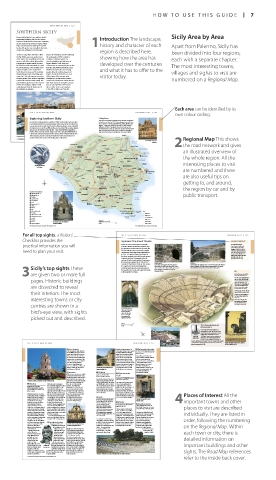
Dominated by Mount Etna, southern Sicily’s Sicily Area by Area
permanent backdrop, this area is a curious Introduction The landscape,
mixture of fertile land and intensive cultivation,
ancient monuments and utter neglect. Many 1history and character of each
towns and monuments built by the ancient Apart from Palermo, Sicily has
Greeks still survive, most notably in the town
of Syracuse, birthplace of Archimedes. region is described here, been divided into four regions,
Southern Sicily, which the Arabs called Inland, the rebuilding of towns following
the Val di Noto, presents another facet the earthquake of 1693 resulted in showing how the area has
of the region. It is very different from the a number of Baroque gems. The each with a separate chapter.
western end of the island, although the churches, buildings and balconies of
topography is equally varied. The west Ragusa, Modica, Scicli, Noto and developed over the centuries
has Phoenician Palermo, while the south Chiaramonte are a triumph of the Sicilian The most interesting towns,
has Greek Syracuse. One of Sicily’s most Baroque style, with their majestic steps,
important sights is the stony-tiered detailed ornamentation and curving and what it has to offer to the
Greek theatre in Syracuse. The tradition façades. Ibla, the medieval quarter of villages and sights to visit are
of performing ancient Greek plays was Ragusa, should be included on a tour
revived in 1914, and now every summer of the towns of the interior; rocky visitor today.
the great works of the ancient tragedians Caltagirone is an important ceramics numbered on a Regional Map.
come to life in their natural setting. This centre, and Chiaramonte and Vizzini also
part of Sicily is also home to the ancient have their charms. In complete contrast
Greek ruins of Megara Hyblaea, now you can also experience the natural
sadly dominated by the landscape of silence of the rock-cut necropolises
the refineries of Augusta. in the cliffs of Ispica and Pantalica.
Each area can be identified by its
own colour coding.
138 SICIL Y AREA B Y AREA SOUTHERN SICIL Y 139
Exploring Southern Sicily Getting There
There are several ways of getting to the interior of southern
An excellent starting point for any visit to Sicily’s southern tip is Syracuse, with Sicily. You can take road SS115 from Agrigento to Gela, then
its exceptional artistic and cultural heritage. It lies about 60 km (37 miles) from on to Syracuse – passing through Noto, Ispica, Modica and
Catania airport and is a two-hour drive from Messina, along a scenic route with follow the A194 to Caltagirone, then bear south, or take
Ragusa – opting for detours if you wish, or, from Catania,
the Ionian Sea to your left and Mount Etna to your right. Other popular sights in motorway A18 to Syracuse. Syracuse can also be reached by
this area are the old cities in the interior – those in Val di Noto (Caltagirone, train. To begin your tour here, you can fly from mainland
Modica, Noto, Palazzolo Acreide, Ragusa and Scicli, along with Militello Val di Italy and other European destinations to Comiso airport.
Catania and Catania itself) have all been named UNESCO World Heritage sites.
The mountains conceal an impressive testimony to the ancient history of
Fishing boats moored at Ortygia harbour in Syracuse Gornalunga Catania
southern Sicily in the crevices of Pantalica, Ispica and Lentini.
d i C a t a n i a
Detail from the Baroque façade of the Duomo in Ortygia Ramacca P i a n a View of Ortygia island, part Regional Map This shows
Ferro Golfo di of Syracuse
Catania
Calttanissetta Palagonia 2the road network and gives
Mirabella Agnone Bagni
Imbaccari
Scordia Capo Campolato
San Cono
San Michele LENTINI
di Ganzaria Militello an illustrated overview of
Mineo Carlentini Capo Santa
CALTAGIRONE Francofonte Croce
AUGUSTA the whole region. All the
Lago di Grammichele MEGARA HYBLAEA Golfo di
Butera Disueri Gela Licodia Sortino Melilli Augusta
Niscemi Eubea VIZZINI Penisola interesting places to visit
Magnisi
Ceramic plate produced Lago di Buccheri PANTALICA
in Caltagirone Maróglio Diriillo Ferla
Agrigento Santo Pietro Anapo Solarino Castello Eurialo are numbered and there
Disshiara Monterosso M o n t i I b l e i
Ficuzza Acate o Acate CHIARAMONTE PALAZZOLO Canicattini are also useful tips on
GELA Almo Giarratana Buscemi Florídia SYRACUSE
Ortygia
Dirillo
Bagni
ACREIDE
GULFI
Diligenza Cassibile Ognina
Golfo Lago di getting to, and around,
di Gela Rosalia V a l d i N o t o Cassibile
Noto Antica
Cómiso Casa Nobile
VITTORIA RAGUSA Avola the region by car and by
Sights at a Glance Scoglitti Tellaro NOTO Calabernardo
1 Syracuse pp140–47 Donnafugata public transport.
2 Noto pp148–51 Irminio MODICA CAVA D'ISPICA
3 Pachino Modica Grande Golfo
4 Capo Passero Punta Secca Rosolini di Noto
5 Cava d’Ispica SCICLI
6 Scicli Marina Ispica
7 Ragusa pp154–5 di Ragusa Marzamemi
8 Modica Donnalucata Sampieri Pozzallo
9 Vittoria PACHINO
0 Gela
Punta
e Palazzolo Acreide Religione Portopalo di Capo Passero Isola Capo Key
Passero
i Pantalica CAPO PASSERO Motorway
q Chiaramonte Gulfi Capo delle Major road
r Caltagirone pp158–9 Isola delle Correnti Secondary road
t Lentini Correnti
u Augusta 0 kilometres 10 Minor road
w Vizzini The Baroque façade of the Basilica di 0 miles 10
Main railway
y Megara Hyblaea San Giorgio in Ragusa Minor railway
For hotels and restaurants see pp202–205 and pp210–217 For additional keys to symbols see back flap
For all top sights, a Visitors’ 142 SICIL Y AREA B Y AREA SOUTHERN SICIL Y 143
Checklist provides the Syracuse: The Greek Theatre VISITORS’ CHECKLIST
practical information you will This is one of the most important examples Practical Information
Greek Theatre and Neapolis
of ancient theatre architecture anywhere, and
Archaeological Zone: Viale
need to plan your visit. for centuries it was the centre of Syracusan life. Paradiso 14. Tel 0931-662 06.
Open 9am–6pm daily. Closed
The Greek theatre was a much more complex
Mon. & Istituto Nazionale del
construction than today’s ruins might indicate;
in 1520–31, Emperor Charles V had much of Dramma Antico (INDA): Corso
Matteotti 29. Tel 0931-487 200.
the stone transported to build the walls around Box office: 0931-487 248.
Ortygia (see pp146–7). Designed in the 5th ∑ indafondazione.org
century BC by the Greek architect Damacopos,
the theatre was enlarged in the 3rd and 2nd Votive Niches Galleries
centuries BC by Hieron II. From the 5th century To the west of the grotto, near the ancient Called criptae, the galleries were cut out of the rock in the Roman
Sicily’s top sights These BC onwards, the great Greek playwrights, colonnade, the wall is punctuated by a series period to replace the more ancient passageways of the cavea,
of rectangular niches that might have housed
including Aeschylus, who premiered some of
which had been removed to create more seating space.
votive paintings or tablets in honour of
his tragedies here, wrote and staged their works
3are given two or more full in this magnificent setting. Syracusan heroes. KEY 1 The diazoma divided the
auditorium into two parts.
pages. Historic buildings 2 The cavea (auditorium) is
over 138 m (453 ft) wide with
67 tiers, divided into 10 vertical
blocks (or “wedges”). Each
block was served by a flight of
are dissected to reveal steps and was indicated by a
letter, a custom that survives
in modern theatres today.
their interiors. The most 3 The stage area was greatly
enlarged in the Roman period.
4 Two enormous pillars of
rock stood either side of the
interesting towns or city stage area.
5 On the orchestra was
a monument to Dionysus,
centres are shown in a Grotta del Museion around which the chorus
acted, danced and sang.
bird’s-eye view, with sights This cave, hewn out
of the rock wall
above the theatre,
has a rectangular
picked out and described. basin where the
aqueduct flowed.
0 metres 10
0 yards 10 The Istituto Nazionale del
Dramma Antico
On 16 April 1914, the tradition of
performing ancient Greek theatre was
revived at Syracuse, and now a season
of plays first performed here over
Logo of the 2,500 years ago is put on every year in
Syracuse INDA May/June. The Istituto Nazio nale del
Dramma Antico (National Institute of
Ancient Drama) was set up in 1925. The Scuola Professionale
Classical Greek Theatre 157
156 SICIL Y AREA B Y AREA SOUTHERN SICIL Y di Teatro Antico (Professional School of Ancient Theatre) Playbill of Aeschylus’ Libation Bearers designed
Every year, the theatre hosts a summer joined as partners in 1983. by Duilio Cambellotti (1921)
programme of Classical theatre.
For hotels and restaurants in this region see p204 and pp214–16
P Corso Umberto I period of abandonment, by e Palazzolo Acreide
The many interesting churches Frederick II. Today Gela is marred Road map E4. * 9,000. n Town hall
and buildings along the town’s by ugly buildings, industrial (0931-871 260).
main street include the former plants and a strong anti-Mafia
Monastero delle Benedettine military presence. However, Originally named Akrai, this
(a convent for Benedictine nuns there are the archaeological town, a UNESCO World Heritage
now used as a courthouse), the sites: a long stretch of Greek site, has some important
19th-century Teatro Garibaldi, fortifications built by Timoleon Baroque churches and buildings
the 18th-century Palazzo at Capo So prano and the sacred – the Chiesa Madre di San
Tedeschi, Santa Maria del precinct and ancient Temple of Nicolò, Palazzo Zocco and
Soccorso and Palazzo Manenti, Athena on the Acropolis, all the 18th-century Chiesa
whose corbels are decorated The ruins of the Greek walls at the Capo good introductions to a visit dell’Annunziata. However, the
with figures of all kinds. Soprano headland, Gela to the Museo Archeologico. most interesting sight is the
peaceful plain with the
R San Pietro 9 Vittoria q Chiaramonte excavations of Akrai.
Also on Corso Umberto I is a flight Road map D5. * 54,300.
of Baroque monumental steps, n Pro Loco (0932-992 953). Gulfi
flanked by statues of the Apostles, Road map E4. * 8,000. ∑ comune.
which leads to the entrance of Founded by Vittoria Colonna in chiaramonte-gulfi.gov.it
The Duomo at Modica, a remarkable example of Sicilian Baroque San Pietro. This church was built 1603, this agricultural town lies This town was founded in the
on the plain between the Ippari
after the 1693 earthquake on
8 Modica R Duomo (San Giorgio) the site of a 14th-century and Dirillo rivers. In the central 14th century by Manfredi
Road map E5. * 52,500. It is worthwhile making the effort church. The Madonna Piazza del Popolo are the Teatro Chiaramonte, the Count of
to climb up the hill to see the
dell’Ausilio, a Gagini-school
Modica, on the steep slopes of
Comunale (1877) and Santa
V from Syracuse (0931-464 467). Cathedral. It is dedica ted to statue, stands in the second Maria delle Grazie, a Baroque a rise and then developed
n Town hall, Corso Umberto I 141, St George and was built by Count chapel in the right-hand aisle. church built after the disastrous towards the valley. The Chiesa
(0932-759 634).
Alfonso Henriquez Cabrera on To the right of San Pietro is 1693 earthquake. del Salvatore and Matrice Santa
Inhabited since the era of the the site of a 13th-century church the 12th-century cave-church Maria la Nova are in the centre, Places of Interest All the
Siculi culture, Modica (a UNESCO which had been destroyed by of San Nicolò Inferiore while the Madonna delle Grazie
World Heritage site) rebelled an earthquake. The magnificent (St Nicholas). Discovered in 0 Gela Sanctuary is on the outskirts.
against Roman rule in 212 BC façade (which, because of its the 20th century, it houses Road map D4. * 72,000. V from A Baroque balcony in the centre of
and, thanks to its strategic similarity to several churches Byzantine wall paintings. Syracuse (892 021). n AAST (0931- Palazzolo Acreide 4important towns and other
position, became one of the in Noto, is attributed to the 462 711). Fortifications at Capo w Vizzini
most important towns in architect Rosario Gagliardi) rises Soprano: Tel 0933-912 626. Road map E4. * 7,000. n Town T Excavations at Akrai
medieval and Renaissance upwards elegantly with three Open 9am–1 hr before sunset. hall (0933-968 211). 2 km (1 mile) from the centre. Tel
Sicily. Peter I of Aragón made it ranks of columns. In the interior, Museo Archeologico Comunale: 0931-876 602. Open 9am–1 hr before places to visit are described
capital of an area that roughly there is a polittico by Bernardino Tel 0933-912 626. Open 9am–6pm. The fascination of Vizzini lies
sunset (Nov–Apr: 9–1pm, 3:30–5pm).
corresponds to the present-day Niger made of ten 16th-century Closed Mon; winter: Sun & hols. in the small streets and alleys
province of Ragusa, and it was wooden panels with scenes from & (combined with excavations.) of the old town, which has This area was inhabited in 664
later ruled by the Chiaramonte the New Testament. Acropolis excava tions: Open 9am–1 hr preserved its atmosphere and BC, when the city was founded individually. They are listed in
and Cabrera families. Perched Corso Regina Margherita, the before sunset. & town plan – increasingly rare in by the Syracusans. A small
on the rocky spurs dominating main street in Modica Alta, has Sicily because of modern urban theatre stands by the entrance.
the large “Y” formed by the many fine 19th-century palazzos. According to Greek historian growth. Also worth a look is the The acropolis contains an
confluence of the Janni Mauro Thucydides, Gela was founded fine architecture of the Chiesa agora, two latomie (the order, following the numbering
and Pozzo Pruni rivers, Modica R Santa Maria di Betlem in 688 BC. In the 6th century BC Madre di San Gregorio with its Intagliata and Intagliatella
grew, occupying the valley By going up the road San Pietro church, standing at the top of its inhabitants founded Gothic portal, taken from the quarries, see p140), the ruins
where the rivers were following one branch of a monumental Baroque staircase Agrigento. Extending over two destroyed Palazzo di Città. of the Temple of Aphrodite on the Regional Map. Within
filled in after a disastrous the confluence of the slopes – the present-day and the so-called Santoni,
series of floods. valley rivers, now E Museo Civico Belgiorno Acropolis and the Capo 12 rock-hewn statues
Modica Alta is built called Via Marchesa Corso Umberto I, 149. Tel 0932-759 Soprano area – the town representing the
on the hill and is Tedeschi, you will 642. Open Summer: 10am– 1pm, was revived, after a long goddess Cybele. each town or city, there is
connected to the lower come across the 5–8pm Tue–Sun; winter: 9am–1pm,
town, Modica Bassa, façade of Santa
3:30–7:30pm Tue–Sun. &
via flights of steps. Maria di Betlem, a Fossils and majolica tiles are
Some of these are 16th-century church featured in this museum, along- detailed information on
monumental, such which was rebuilt side Greek and Roman ceramics
as the 250-step after the 1693 earth- and artifacts recovered from
flight built in the 19th quake. Inside the end of graves in the Modica area,
century which descends Sculpture on the right-hand aisle is the including the archaeological important buildings and other
from San Giorgio. Alleys Corso Umberto I Cappella del Sacramento, site of Cava d’Ispica. High lights
and lanes evoke the a splendid example of late include a bronze statuette of
walled town, which from 844 Gothic-Renaissance architecture. Hercules, which is Hellenic in sights. The Road Map references
to 1091 was an important Arab It was commissioned by the style and dates back to the
city known as Mohac. Cabrera family. 3rd century BC. The theatre at Palazzolo Acreide: the colony dates back to the early 7th century BC
refer to the inside back cover.
For hotels and restaurants in this region see p204 and pp214–16
006-007_EW_Sicily.indd 7 11/3/16 2:06 PM

