


Page 193 - (DK Eyewitness) Travel Guide - Europe
P. 193
FR ANCE 191
z Avignon l’Horloge is the center of
Avignon’s social life. Under the
Vaucluse. * 100,000. k £ @
n 41 Cours Jean Jaurès town hall’s Gothic clock tower
(04-32 74 32 74). ( Tue–Sun. stands a merry-go-round from
_ Le Festival d’Avignon (Jul). 1900. Until the 19th century,
∑ avignon-tourisme.com brightly patterned calicoes
called indiennes were printed
Massive ramparts enclose nearby. These inspired today’s
this fascinating town. The Provençal patterns.
huge Palais des Papes is From early July for three
the dominant feature, but Open-air performance at the annual weeks, the Avignon Festival
Avignon contains other riches. Avignon Festival takes place at the Palais des
To the north of the Palais is the Papes. France’s largest festival,
13th-century Musée du Petit de Notre-Dame-des-Doms, it includes ballet, drama, and
Palais, once the Archbishop with its Romanesque cupola classical concerts. The “Off”
of Avignon’s residence. It has and papal tombs, and the festival has street theater and
received such notorious guests 14th-century Eglise St-Didier. music from folk to jazz.
as Cesare Borgia and Louis XIV. The Musée Lapidaire The Pont St-Bénézet, built
Now a museum, it displays contains statues, mosaics, and from 1171–1185, once had
Romanesque and Gothic carvings from pre-Roman 22 arches, but most were des-
sculpture and paintings of Provence. The Musée Calvet troyed by floods in 1668. One
the Avignon and Italian features a superb array of of the remaining arches bears
schools, with works by exhibits, including Roman finds. the tiny Chapelle St-Nicolas.
Botticelli and Carpaccio. It also gives an overview of
Avignon boasts some fine French art during the past 500 + Palais des Papes
churches, such as the years, with works by Rodin, Place du Palais-des-Papes. Tel 04-32
12th-century Cathédrale Manet, and Dufy. The Place de 74 32 74. Open daily. & 8
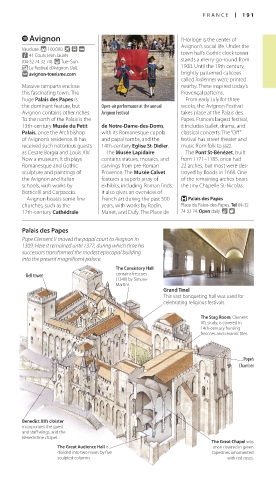
Palais des Papes
Pope Clement V moved the papal court to Avignon in
1309. Here it remained until 1377, during which time his
successors transformed the modest episcopal building
into the present magnificent palace.
The Consistory Hall
Bell tower contains frescoes
(1340) by Simone
Martini.
Grand Tinel
This vast banqueting hall was used for
celebrating religious festivals.
The Stag Room, Clement
VI’s study, is covered in
14th-century hunting
frescoes and ceramic tiles.
Pope’s
Chamber
Benedict XII’s cloister
incorporates the guest
and staff wings, and the
Benedictine chapel.
The Great Chapel was
The Great Audience Hall is once covered in green
divided into two naves by five tapestries ornamented
sculpted columns. with red roses.
190-191_EW_Europe.indd 191 14/07/16 10:14 am

