


Page 196 - (DK Eyewitness) Travel Guide - Europe
P. 196
194 FR ANCE AND THE L OW C OUNTRIES
c Camargue paintings to Aix. Work by
Provençal artists, including
Bouches-du-Rhône. £ @ n 5 Ave Cézanne, is also shown.
Van Gogh, Stes-Maries-de-la-Mer
(04-90 97 82 55). _ Pèlerinage des E Musée Granet
Gitans (end May & end Oct).
∑ saintesmaries.com 13 Rue Cardinale. Tel 04-42 52 88 32.
Open Tue–Sun. & 7
This flat, sparsely populated
land is one of Europe’s major
wetland regions and natural- b Marseille
history sites. Extensive areas of Bouches-du-Rhône. * 1,000,000.
salt marshes, lakes, pastures, k 25 km NW. g £ @ n 11 La
and sand dunes cover a vast Canebière (08-26 50 05 00). ( daily.
140,000 ha (346,000 acres). The ∑ marseille-tourisme.com
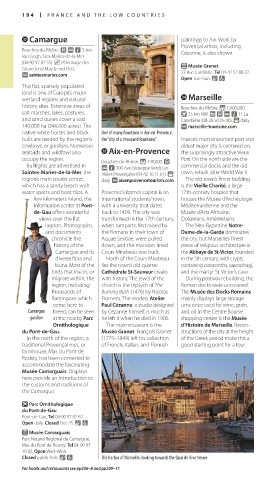
native white horses and black One of many fountains in Aix-en-Provence,
bulls are tended by the region’s the “city of a thousand fountains” France’s most important port and
cow boys, or gardians. Numerous oldest major city is centered on
seabirds and wildfowl also v Aix-en-Provence the surprisingly attractive Vieux
occupy the region. Bouches-du-Rhône. * 140,000. £ Port. On the north side are the
Bullfights are advertised in @ n 300 Ave Giuseppe Verdi, Les commercial docks and the old
Saintes-Maries-de-la-Mer, the Allées Provençales (04-42 16 11 61). ( town, rebuilt after World War II.
region’s main tourist center, daily. ∑ aixenprovencetourism.com The old town’s finest building
which has a sandy beach with is the Vieille Charité, a large
water sports and boat trips. A Provence’s former capital is an 17th-century hospice that
few kilometers inland, the international students’ town, houses the Musée d’Archéologie
information center at Pont- with a university that dates Méditerranéenne and the
de-Gau offers wonderful back to 1409. The city was Musée d’Arts Africains,
views over the flat transformed in the 17th century, Océaniens, Amérindiens.
lagoon. Photographs when ramparts, first raised by The Neo-Byzantine Notre-
and documents the Romans in their town of Dame-de-la-Garde dominates
chronicle the Aquae Sextiae, were pulled the city, but Marseille’s finest
history of the down, and the mansion-lined piece of religious architecture is
Camargue and its Cours Mirabeau was built. the Abbaye de St-Victor, founded
diverse flora and North of the Cours Mirabeau in the 5th century, with crypts
fauna. Most of the lies the town’s old quarter. conta ining catacombs, sarcophagi,
birds that live in, or Cathédrale St-Sauveur creaks and the martyr St. Victor’s cave.
migrate within, the with history. The jewel of the During postwar rebuilding, the
region, inclu ding church is the triptych of The Roman docks were uncovered.
thousands of Burning Bush (1476) by Nicolas The Musée des Docks Romains
flamingoes which Froment. The modest Atelier mainly displays large storage
come here to Paul Cézanne, a studio designed urns once used for wine, grain,
Camargue breed, can be seen by Cézanne himself, is much as and oil. In the Centre Bourse
gardian at the nearby Parc he left it when he died in 1906. shopping center is the Musée
Ornithologique The main museum is the d’Histoire de Marseille. Recon-
du Pont-de-Gau. Musée Granet. François Granet structions of the city at the height
In the north of the region, a (1775–1849) left his collection of the Greek period make this a
traditional Provençal mas, or of French, Italian, and Flemish good starting point for a tour.
farmhouse, Mas du Pont de
Rousty, has been converted to
accommodate the fascinating
Musée Camarguais. Displays
here provide an introduction to
the customs and traditions of
the Camargue.
O Parc Ornithologique
du Pont-de-Gau
Pont-de-Gau. Tel 04-90 97 82 62.
Open daily. Closed Dec 25. & 7
E Musée Camarguais
Parc Naturel Régional de Camargue,
Mas du Pont de Rousty. Tel 04-90 97
10 82. Open Wed–Mon.
Closed public hols. & 7 Old harbor of Marseille, looking towards the Quai de Rive Neuve
For hotels and restaurants see pp206–8 and pp209–11
194-195_EW_Europe.indd 194 14/07/16 10:09 am

