


Page 220 - (DK Eyewitness) Travel Guide - Europe
P. 220
218 FR ANCE AND THE L OW C OUNTRIES
2 Musée du
Costume et de la
Dentelle
Rue de Violette 12. Tel 02-213 4450.
q Gare Centrale. @ 48, 95. Open
10am–5pm Tue–Sun. &
8 on request. 7 restricted.
Located within two 18th-
century gabled houses, this
museum is dedicated to one
of Brussels’ most successful
exports, Belgian lace, which
has been made here since the
12th century. The ground floor
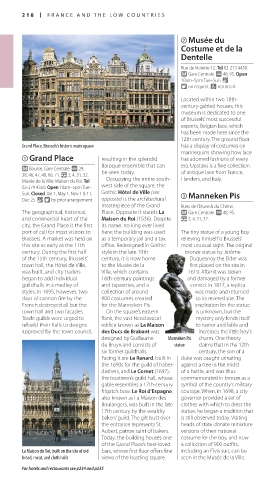
Grand Place, Brussels’s historic main square has a display of costumes on
mannequins showing how lace
1 Grand Place resulting in the splendid has adorned fashions of every
Baroque ensemble that can era. Upstairs is a fine collection
q Bourse, Gare Centrale. @ 29,
38, 46, 47, 48, 66, 71. v 3, 4, 31, 32. be seen today. of antique lace from France,
Musée de la Ville: Maison du Roi. Tel Occupying the entire south- Flanders, and Italy.
02-279 4350. Open 10am–5pm Tue– west side of the square, the
Sun. Closed Jan 1, May 1, Nov 1 & 11, Gothic Hôtel de Ville (see 3 Manneken Pis
Dec 25. & 8 by prior arrangement. opposite) is the architectural
masterpiece of the Grand Rues de l’Etuve & du Chêne.
The geographical, historical, Place. Opposite it stands La q Gare Centrale. @ 48, 95.
and commercial heart of the Maison du Roi (1536). Despite v 3, 4, 31, 32.
city, the Grand Place is the first its name, no king ever lived
port of call for most visitors to here; the building was used The tiny statue of a young boy
Brussels. A market was held on as a temporary jail and a tax relieving himself is Brussels’
this site as early as the 11th office. Redesigned in Gothic most unusual sight. The original
century. During the first half style in the late 19th bronze statue by Jérôme
of the 15th century, Brussels’ century, it is now home Duquesnoy the Elder was
town hall, the Hôtel de Ville, to the Musée de la first placed on the site in
was built, and city traders Ville, which contains 1619. After it was stolen
began to add individual 16th-century paintings and damaged by a former
guildhalls in a medley of and tapestries, and a convict in 1817, a replica
styles. In 1695, however, two collection of around was made and returned
days of cannon fire by the 900 costumes created to its revered site. The
French destroyed all but the for the Manneken Pis. inspiration for the statue
town hall and two facades. On the square’s eastern is unknown, but the
Trade guilds were urged to flank, the vast Neoclassical mystery only lends itself
rebuild their halls to designs edifice known as La Maison to rumor and fable and
approved by the town council, des Ducs de Brabant was increases the little boy’s
designed by Guillaume Manneken Pis charm. One theory
de Bruyn and consists of statue claims that in the 12th
six former guildhalls. century, the son of a
Facing it are Le Renard, built in duke was caught urinating
the 1690s for the guild of haber- against a tree in the midst
dashers, and Le Cornet (1697), of a battle, and was thus
the boatmen’s guild hall, whose commemorated in bronze as a
gable resembles a 17th-century symbol of the country’s military
frigate’s bow. Le Roi d’Espagne, courage. When, in 1698, a city
also known as La Maison des governor provided a set of
Boulangers, was built in the late clothes with which to dress the
17th century by the wealthy statue, he began a tradition that
bakers’ guild. The gilt bust over is still observed today. Visiting
the entrance represents St. heads of state donate miniature
Aubert, patron saint of bakers. versions of their national
Today, the building houses one costume for the boy, and now
of the Grand Place’s best-loved a collection of 900 outfits,
La Maison du Roi, built on the site of old bars, whose first floor offers fine including an Elvis suit, can be
bread, meat, and cloth halls views of the bustling square. seen in the Musée de la Ville.
For hotels and restaurants see p234 and p235
218-219_EW_Europe.indd 218 14/07/16 10:14 am

