


Page 223 - (DK Eyewitness) Travel Guide - Europe
P. 223
BRUSSELS 221
among his religious canvases.
Other notable paintings include
van Dyck’s Portrait of Porzia
Imperial with her daughter Maria
Francesca (1620s) and Three
Children with Goatcart by Frans
Hals (c.1582–1666).
The Musée Fin-de-Siècle
focuses on the years between
1868 and 1914, during which
Brussels was the artistic capital
of Europe, thanks to the efforts
of James Ensor, Constantin
Meunier, and Victor Horta,
among others. In addition to
visual arts, the museum
explores the literature, poetry
and music of the period. One of
the highlights of this collection
is a 3D reconstruction of six Art
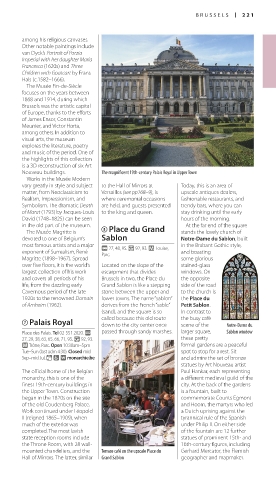
Nouveau buildings. The magnificent 19th-century Palais Royal in Upper Town
Works in the Musée Modern
vary greatly in style and subject to the Hall of Mirrors at Today, this is an area of
matter, from Neoclassicism to Versailles (see pp168–9), is upscale antiques dealers,
Realism, Impressionism, and where ceremonial occasions fashionable restaurants, and
Symbolism. The dramatic Death are held, and guests presented trendy bars, where you can
of Marat (1793) by Jacques-Louis to the king and queen. stay drinking until the early
David (1748–1825) can be seen hours of the morning.
in the old part of the museum. 8 Place du Grand At the far end of the square
The Musée Magritte is stands the lovely church of
devoted to one of Belgium’s Sablon Notre-Dame du Sablon, built
most famous artists and a major @ 27, 48, 95. v 92, 93. q Louise, in the Brabant Gothic style,
exponent of Surrealism, René Parc. and boasting
Magritte (1898–1967). Spread some glorious
over five floors, it is the world’s Located on the slope of the stained-glass
largest collection of his work escarpment that divides windows. On
and covers all periods of his Brussels in two, the Place du the opposite
life, from the dazzling early Grand Sablon is like a stepping side of the road
Cavernous period of the late stone between the upper and to the church is
1920s to the renowned Domain lower towns. The name “sablon” the Place du
of Arnheim (1962). derives from the French “sable” Petit Sablon.
(sand), and the square is so In contrast to
7 Palais Royal called because this old route the busy café Notre-Dame du
scene of the
down to the city center once
Place des Palais. Tel 02-551 2020. @ passed through sandy marshes. larger square, Sablon window
27, 29, 38, 63, 65, 66, 71, 95. v 92, 93. these pretty
q Trône, Parc. Open 10:30am–5pm formal gardens are a peaceful
Tue–Sun (last adm 4:30). Closed mid- spot to stop for a rest. Sit
Sep–mid-Jul. = 7 ∑ monarchie.be and admire the set of bronze
statues by Art Nouveau artist
The official home of the Belgian Paul Hankar, each representing
monarchy, this is one of the a different medieval guild of the
finest 19th-century buildings in city. At the back of the gardens
the Upper Town. Construction is a fountain, built to
began in the 1820s on the site commemorate Counts Egmont
of the old Coudenberg Palace. and Hoorn, the martyrs who led
Work continued under Léopold a Dutch uprising against the
II (reigned 1865–1909), when tyrannical rule of the Spanish
much of the exterior was under Philip II. On either side
completed. The most lavish of the fountain are 12 further
state reception rooms include statues of prominent 15th- and
the Throne Room, with 28 wall- 16th-century figures, including
mounted chandeliers, and the Terrace café on the upscale Place du Gerhard Mercator, the Flemish
Hall of Mirrors. The latter, similar Grand Sablon geographer and mapmaker.
220-221_EW_Europe.indd 221 14/07/16 10:14 am

