


Page 230 - (DK Eyewitness) Travel Guide - Europe
P. 230
228 FR ANCE AND THE L OW C OUNTRIES
E Groeninge Museum P Begijnhof
Dijver 12. Tel 050-44 8743. Open Wijngaardplein 1. Tel 050-33 0011.
9:30am–5pm (last adm: 4:30pm) Tue– Open daily. & (for Begijn House).
Sun. Closed Jan 1, Dec 25. & Béguines were members of a lay
Bruges’ premier fine-art museum sisterhood founded in 1245,
holds a superb collection of early who did not take vows, but led
Flemish and Dutch masters. a devout life. The begijnhof, or
Artists featured include Rogier béguinage, is the walled
van der Weyden (c.1400–1464), complex in a town that housed
Jan van Eyck (d.1441), and Hans the Béguines. In Bruges, this is
Memling (c.1430–94). Van Eyck’s an area of quiet tree-lined
Virgin and Child with Canon canals edged by white, gabled
(1436), a richly detailed painting houses. Visitors can enjoy a stroll
noted for its realism, and here and visit the simple church,
Memling’s Moreel triptych (1484) built in 1602. One of the houses,
are among the museum’s most now occupied by Benedictine
outstanding exhibits. Painted in nuns, is open to the public.
the early 16th century, the Last
Judgment triptych is one of a E Houishbrouwerij de
number of works at the museum Halve Maan
by Hieronymous Bosch (c.1450– Walplein 26. Tel 050-44 4222. Open
1516). Peter Brueghel the 11am–4pm Sun–Fri, 11am–5pm Sat
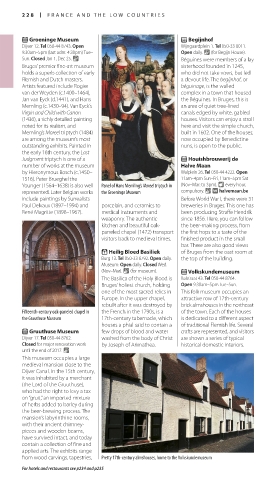
Younger (1564–1638) is also well Panel of Hans Memling’s Moreel triptych in (Nov–Mar: to 3pm). 8 every hour,
represented. Later Belgian works the Groeninge Museum compulsory. & ∑ halvemaan.be
include paintings by Surrealists Before World War I, there were 31
Paul Delvaux (1897–1994) and porcelain, and ceramics to breweries in Bruges. This one has
René Magritte (1898–1967). medical instruments and been producing Straffe Hendrik
weaponry. The authentic since 1856. Here, you can follow
kitchen and beautiful oak- the beer-making process, from
paneled chapel (1472) transport the first hops to a taste of the
visitors back to medieval times. finished product in the small
bar. There are also good views
R Heilig Bloed Basiliek of Bruges from the oast room at
Burg 13. Tel 050-33 6792. Open daily. the top of the building.
Museum: Open daily. Closed Wed
(Nov–Mar). & (for museum). E Volkskundemuseum
The Basilica of the Holy Blood is Balstraat 43. Tel 050-44 8764.
Bruges’ holiest church, holding Open 9:30am–5pm Tue–Sun.
one of the most sacred relics in This folk museum occupies an
Europe. In the upper chapel, attractive row of 17th-century
rebuilt after it was destroyed by brick almshouses in the northeast
Fifteenth-century oak-paneled chapel in the French in the 1790s, is a of the town. Each of the houses
the Gruuthuse Museum 17th-century tabernacle, which is dedicated to a different aspect
houses a phial said to contain a of traditional Flemish life. Several
E Gruuthuse Museum few drops of blood and water crafts are represented, and visitors
Dijver 17. Tel 050-44 8762. washed from the body of Christ are shown a series of typical
Closed for major renovation work by Joseph of Arimathea. historical domestic interiors.
until the end of 2017. &
This museum occupies a large
medieval mansion close to the
Dijver Canal. In the 15th century,
it was inhabited by a merchant
(the Lord of the Gruuthuse),
who had the right to levy a tax
on “gruit,” an imported mixture
of herbs added to barley during
the beer-brewing process. The
mansion’s labyrinthine rooms,
with their ancient chimney-
pieces and wooden beams,
have survived intact, and today
contain a collection of fine and
applied arts. The exhibits range
from wood carvings, tapestries, Pretty 17th-century almshouses, home to the Volkskundemuseum
For hotels and restaurants see p234 and p235
228-229_EW_Europe.indd 228 14/07/16 10:14 am

