


Page 239 - (DK Eyewitness) Travel Guide - Europe
P. 239
FR ANCE AND THE L OW C OUNTRIES 237
THE NETHERLANDS
Situated at the mouth of the Rhine River, the Netherlands is a man-made
country that owes its life to the sea: much of the land once lay under water, and
a maritime trading tradition was the principal source of the nation’s wealth,
most notably in the 17th century. The Netherlands is also one of the world’s
most liberal countries, with a long history of cultural and racial tolerance.
The shape of the Netherlands (or Holland, are all in the west of the country and part
as it is also known) has changed dramatically of the urban conglo meration known as
over the last 2,000 years. Medieval maps the Randstad.
show nearly half of the country under
water, but since then, large areas have History
been reclaimed from the sea; the current Between the 4th and 8th centuries, after
shoreline is maintained by a drainage the collapse of the Roman Empire, the
system of windmills, dykes, and canals. area corresponding to present-day
With just under 17 million people in just Holland was conquered by the Franks.
41,547 sq km (16,041 sq miles) of land, it is As with all the Low Countries, it was later
the third most densely populated country ruled by the House of Burgundy, before
in Europe (after Monaco and Malta), but passing into the hands of the Habsburgs.
this is barely perceptible to the visitor. Only When the Habsburg Empire was divided
when arriving by plane do you see how in 1555, the region came under the
much of the area is still covered with water, control of the Spanish branch of the
and how little precious land remains. The family, which caused the Dutch Revolt
orderly Dutch cities and towns never seem of 1568, led by William I of Orange. The
overcrowded, but homes are often small, Dutch Republic was finally established
with steep, narrow staircases and modest in 1579, with the Treaty of Utrecht, but it
gardens. Given the fragility of their took until 1648 for the Spanish officially
environment, it is understandable that the to recognize its sovereignty.
Dutch are so good at preserving it. The battle for independence and the
The three biggest cities – Amsterdam, need for wealth to fight the Spanish
the capital, Rotterdam, the industrial hub, armies stimulated trading success
and the Hague, the seat of government – overseas. The Dutch colonized much of
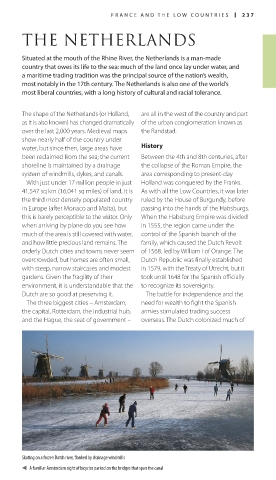
Skating on a frozen Dutch river, flanked by drainage windmills
A familiar Amsterdam sight of bicycles parked on the bridges that span the canal
236-239_EW_Europe.indd 237 14/07/16 10:14 am

