


Page 271 - (DK Eyewitness) Travel Guide - Europe
P. 271
SP AIN 269
Barcelona hosted the Olympic Games
and Seville was the site of Expo ’92.
With the establishment of democracy,
the 17 autonomous regions of Spain
have acquired considerable power.
A significant number of Basques favor
independence for the Basque Country.
The Basque terrorist group ETA declared
a ceasefire in 2011. There is a significant
independence movement in Catalonia,
led by Catalan President Artur Mas.
Religion, Language, and Culture
Following the Christian Reconquest in the
Middle Ages, a succession of rulers tried to
impose a common culture, but today
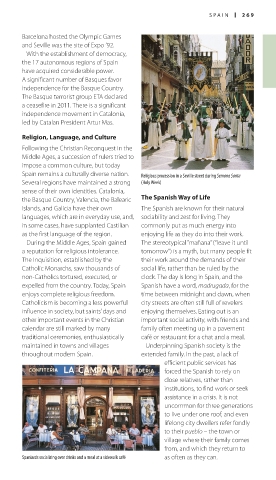
Spain remains a culturally diverse nation. Religious procession in a Seville street during Semana Santa
Several regions have maintained a strong (Holy Week)
sense of their own identities. Catalonia,
the Basque Country, Valencia, the Balearic The Spanish Way of Life
Islands, and Galicia have their own The Spanish are known for their natural
languages, which are in everyday use, and, sociability and zest for living. They
in some cases, have supplanted Castilian commonly put as much energy into
as the first language of the region. enjoying life as they do into their work.
During the Middle Ages, Spain gained The stereotypical “mañana” (“leave it until
a reputation for religious intolerance. tomorrow”) is a myth, but many people fit
The Inquisition, established by the their work around the demands of their
Catholic Monarchs, saw thousands of social life, rather than be ruled by the
General Franco, Nationalist leader non-Catholics tortured, executed, or clock. The day is long in Spain, and the
in the Spanish Civil War expelled from the country. Today, Spain Spanish have a word, madrugada, for the
enjoys complete religious freedom. time between midnight and dawn, when
Catholicism is becoming a less powerful city streets are often still full of revelers
influence in society, but saints’ days and enjoying themselves. Eating out is an
other important events in the Christian important social activity, with friends and
calendar are still marked by many family often meeting up in a pavement
traditional ceremonies, enthusiastically café or restaurant for a chat and a meal.
maintained in towns and villages Underpinning Spanish society is the
throughout modern Spain. extended family. In the past, a lack of
efficient public services has
forced the Spanish to rely on
close relatives, rather than
institutions, to find work or seek
assistance in a crisis. It is not
uncommon for three generations
to live under one roof, and even
lifelong city dwellers refer fondly
to their pueblo – the town or
village where their family comes
from, and which they return to
Spaniards socializing over drinks and a meal at a sidewalk café as often as they can.
266-269_EW_Europe.indd 269 14/07/16 10:15 am

