


Page 302 - (DK Eyewitness) Travel Guide - Europe
P. 302
300 THE IBERIAN PENINSULA
3 La Rambla
q Drassanes, Liceu, Catalunya.
Busy around the clock, this is
one of the most famous streets
in Spain. A stroll down its tree-
shaded, central walkway to the
seafront, taking in the mansions,
shops, and cafés, makes a
perfect introduction to
Barcelona life.
The name comes from the
Arabic ramla, meaning the
dried-up bed of a seasonal river.
Barcelona’s 13th-century city
wall followed the left bank of
one such river. During the 16th
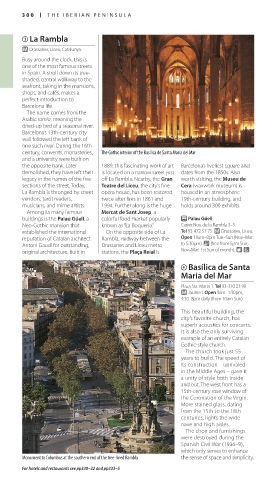
century, convents, monasteries, The Gothic interior of the Basílica de Santa Maria del Mar
and a university were built on
the opposite bank. Later 1889, this fascinating work of art Barcelona’s liveliest square and
demolished, they have left their is located on a narrow street just dates from the 1850s. Also
legacy in the names of the five off La Rambla. Nearby, the Gran worth visiting, the Museu de
sections of the street. Today, Teatre del Liceu, the city’s fine Cera (waxwork museum) is
La Rambla is thronged by street opera house, has been restored housed in an atmospheric
vendors, tarot readers, twice after fires in 1861 and 19th-century building, and
musicians, and mime artists. 1994. Further along is the huge holds around 300 exhibits.
Among its many famous Mercat de Sant Josep, a
buildings is the Palau Güell, a colorful food market popularly P Palau Güell
Neo-Gothic mansion that known as “La Boqueria.” Carrer Nou de la Rambla 3–5.
established the international On the opposite side of La Tel 93-472 57 75. q Drassanes, Liceu.
reputation of Catalan architect Rambla, midway between the Open 10am–8pm Tue–Sun (Nov–Mar:
Antoni Gaudí for outstanding, Drassanes and Liceu metro to 5:30pm). & (free from 5pm Sun;
original architecture. Built in stations, the Plaça Reial is Nov–Mar: 1st Sun of month). 8 7
4 Basílica de Santa
Maria del Mar
Plaza Sta. Maria 1. Tel 93-310 23 90.
q Jaume I. Open 9am–1:30pm,
4:30–8pm daily (from 10am Sun).
This beautiful building, the
city’s favorite church, has
superb acoustics for concerts.
It is also the only surviving
example of an entirely Catalan
Gothic-style church.
The church took just 55
years to build. The speed of
its construction – unrivaled
in the Middle Ages – gave it
a unity of style both inside
and out. The west front has a
15th-century rose window of
the Coronation of the Virgin.
More stained glass, dating
from the 15th to the 18th
centuries, lights the wide
nave and high aisles.
The choir and furnishings
were destroyed during the
Spanish Civil War (1936–9),
which only serves to enhance
Monument to Columbus at the southern end of the tree-lined Rambla the sense of space and simplicity.
For hotels and restaurants see pp330–32 and pp333–5
300-301_EW_Europe.indd 300 14/07/16 10:09 am

