


Page 304 - (DK Eyewitness) Travel Guide - Europe
P. 304
302 THE IBERIAN PENINSULA
7 Sagrada Família
Europe’s most unconventional church, the Temple Expiatori
de la Sagrada Família is an emblem of a city that likes to think
of itself as individualistic. Full of symbolism inspired by nature
and striving for originality, it is the greatest work of Catalan
architect Antoni Gaudí (1852–1926). In 1883, a year after
work began on a Neo-Gothic church on the site, he was
given the task of completing it. Gaudí changed everything,
extemporizing as he went along. It became his life’s work
and he lived like a recluse on the site for the last few years
of his life. He is buried in the crypt. By the time of his death,
only one tower on the Nativity facade had been completed,
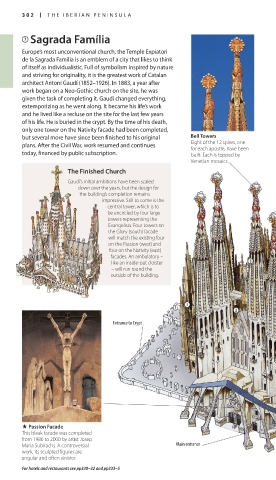
but several more have since been finished to his original Bell Towers
plans. After the Civil War, work resumed and continues Eight of the 12 spires, one
for each apostle, have been
today, financed by public subscription. built. Each is topped by
Venetian mosaics.
The Finished Church
Gaudí’s initial ambitions have been scaled
down over the years, but the design for
the building’s completion remains
impressive. Still to come is the
central tower, which is to
be encircled by four large
towers representing the
Evangelists. Four towers on
the Glory (south) facade
will match the existing four
on the Passion (west) and
four on the Nativity (east)
facades. An ambulatory –
like an inside-out cloister
– will run round the
outside of the building.
Entrance to Crypt
. Passion Facade
This bleak facade was completed
from 1986 to 2000 by artist Josep
Maria Subirachs. A controversial Main entrance
work, its sculpted figures are
angular and often sinister.
For hotels and restaurants see pp330–32 and pp333–5
302-303_EW_Europe.indd 302 14/07/16 10:15 am

