


Page 323 - (DK Eyewitness) Travel Guide - Europe
P. 323
SE VILLE 321
Flamenco
More than just a dance,
flamenco is an artistic
expression of the joys and
sorrows of life. A uniquely
Andalusian art, its origins are
hard to trace. Gypsies may
have been the main creators
of the art, mixing their own
Indian-influenced culture
with existing Moorish and
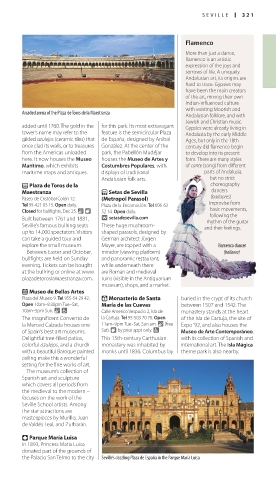
Arcaded arena of the Plaza de Toros de la Maestranza Andalusian folklore, and with
Jewish and Christian music.
added until 1760. The gold in the for this park. Its most extravagant Gypsies were already living in
tower’s name may refer to the feature is the semicircular Plaza Andalusia by the early Middle
gilded azulejos (ceramic tiles) that de España, designed by Aníbal Ages, but only in the 18th
once clad its walls, or to treasures González. At the center of the century did flamenco begin
from the Americas unloaded park, the Pabellón Mudéjar to develop into its present
here. It now houses the Museo houses the Museo de Artes y form. There are many styles
Marítimo, which exhibits Costumbres Populares, with of cante (song) from different
maritime maps and antiques. displays of traditional parts of Andalusia,
Andalusian folk arts. but no strict
P Plaza de Toros de la choreo graphy –
Maestranza P Setas de Sevilla dancers
Paseo de Cristóbal Colón 12. (Metropol Parasol) (bailaores)
Tel 95-421 03 15. Open daily. Plaza de la Encarnación. Tel 606-63 improvise from
Closed for bullfights, Dec 25. & 8 52 14. Open daily. basic movements,
following the
Built between 1761 and 1881, ∑ setasdesevilla.com rhythm of the guitar
Seville’s famous bullring seats These huge mushroom- and their feelings.
up to 14,000 spectators. Visitors shaped parasols, designed by
can take a guided tour and German architect Jürgen
explore the small museum. Mayer, are topped with a Flamenco dancer
Between Easter and October, mirador (viewing platform) (bailaora)
bullfights are held on Sunday and panoramic restaurant,
evening. Tickets can be bought while underneath there
at the bullring or online at www. are Roman and medieval
plazadetoroslamaestranza.com. ruins (visible in the Antiquarium
museum), shops, and a market.
E Museo de Bellas Artes
Plaza del Museo 9. Tel 955-54 29 42. R Monasterio de Santa buried in the crypt of its church
Open 10am–8:30pm Tue–Sat, María de las Cuevas between 1507 and 1542. The
10am–5pm Sun. & 7 Calle Americo Vespucio 2, Isla de monastery stands at the heart
The magnificent Convento de la Cartuja. Tel 95-503 70 70. Open of the Isla de Cartuja, the site of
la Merced Calzada houses one 11am–9pm Tue–Sat, Sun am. & (free Expo ’92, and also houses the
of Spain’s best art museums. Sat). 8 by prior appt only. 7 Museo de Arte Contemporáneo,
Delightful tree-filled patios, This 15th-century Carthusian with its collection of Spanish and
colorful azulejos, and a church monastery was inhabited by international art. The Isla Mágica
with a beautiful Baroque painted monks until 1836. Columbus lay theme park is also nearby.
ceiling make this a wonderful
setting for the fine works of art.
The museum’s collection of
Spanish art and sculpture –
which covers all periods from
the medieval to the modern –
focuses on the work of the
Seville School artists. Among
the star attractions are
masterpieces by Murillo, Juan
de Valdés Leal, and Zurbarán.
Y Parque María Luisa
In 1893, Princess María Luisa
donated part of the grounds of
the Palacio San Telmo to the city Seville’s dazzling Plaza de España in the Parque María Luisa
320-321_EW_Europe.indd 321 14/07/16 10:15 am

