


Page 318 - (DK Eyewitness) Travel Guide - Europe
P. 318
316 THE IBERIAN PENINSULA
Córdoba: the Mezquita
Córdoba’s great mosque, dating back 12
centuries, embodied the power of Islam on
the Iberian Peninsula. Abd al Rahman I
built the original mosque between 785
and 787. The building evolved over the
centuries, blending many architectural
forms. In the 10th century, al Hakam II
made some of the most lavish
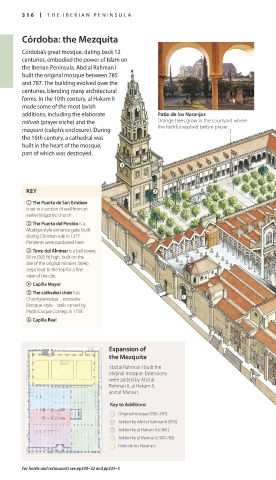
additions, including the elaborate Patio de los Naranjos
mihrab (prayer niche) and the Orange trees grow in the courtyard where
maqsura (caliph’s enclosure). During the faithful washed before prayer.
the 16th century, a cathedral was
built in the heart of the mosque,
part of which was destroyed.
KEY
1 The Puerta de San Esteban
is set in a section of wall from an
earlier Visigothic church.
2 The Puerta del Perdón is a
Mudéjar-style entrance gate, built
during Christian rule in 1377.
Penitents were pardoned here.
3 Torre del Alminar is a bell tower,
93 m (305 ft) high, built on the
site of the original minaret. Steep
steps lead to the top for a fine
view of the city.
4 Capilla Mayor
5 The cathedral choir has
Churrigueresque – excessive
Baroque-style – stalls carved by
Pedro Duque Cornejo in 1758.
6 Capilla Real
Expansion of
the Mezquita
Abd al Rahman I built the
original mosque. Extensions
were added by Abd al
Rahman II, al Hakam II,
and al Mansur.
Key to Additions
Original mosque (785–787)
Added by Abd al Rahman II (833)
Added by al Hakam II (c.961)
Added by al Mansur (c.987–90)
Patio de los Naranjos
For hotels and restaurants see pp330–32 and pp333–5
316-317_EW_Europe.indd 316 14/07/16 10:44 am

