


Page 344 - (DK Eyewitness) Travel Guide - Europe
P. 344
342 THE IBERIAN PENINSULA
1 Oceanário de
Lisboa
Esplanada Dom Carlos I, Parque
das Nações. Tel 218-917 000.
q Oriente. @ 705, 728, 744, 750.
£ Gare do Oriente. Open daily.
& 7 ∑ oceanario.pt
This huge oceanarium, on the
banks of the Tagus, is the
second largest in the world.
It was designed for Expo ’98
by the American architect
Peter Chermayeff to illustrate
the environmental theme of
“The Oceans: A Heritage for
the Future.”
The central feature is a gigantic Statue of woman praying beside tomb of Carlos I in São Vicente de Fora
aquarium, the “Open Tank,” with
enough water to fill four Olympic Panels from churches, to a church and monastery on
swimming pools. Representing monasteries, and other sites this site. The present church
the open ocean, this contains around Portugal have been was completed in 1627. The
fauna of the high seas, from sea reassembled here. Highlights Italianate facade has statues of
bream to sharks. Around the include a blue-and-white, Saints Vincent, Augustine, and
main tank four smaller aquariums 18th-century panorama Sebastian over the entrance.
reconstruct the ecosystems of showing Lisbon before the The church has reopened after
the Atlantic, Antarctic, Pacific, earthquake, and colorful extensive renovation.
and Indian oceans. 17th-century carpet tiles Behind the church is the old
(so-called because they imitated refectory, transformed into the
2 Museu Nacional the patterns of Moorish rugs). Bragança Pantheon in 1885. The
do Azulejo tombs of almost every Bragança
king and queen are here, from
Rua da Madre de Deus 4. Tel 218-100 João IV, who died in 1656, to
340. @ 718, 728, 742, 759, 794. Manuel II, last king of Portugal.
Open Tue–Sun. Closed Jan 1, Easter Only Maria I and Pedro IV are
Sun, May 1, Dec 25. - 0 & not buried here. A stone
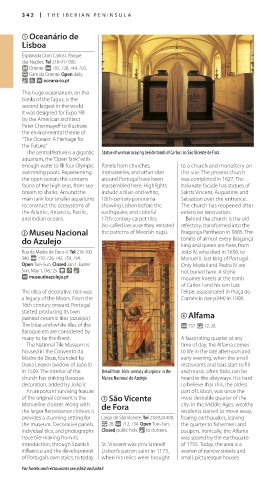
∑ museudoazulejo.pt mourner kneels at the tomb
of Carlos I and his son Luís
The idea of decorative tiles was Felipe, assassinated in Praça do
a legacy of the Moors. From the Comércio (see p344) in 1908.
16th century onward, Portugal
started producing its own 4 Alfama
painted ceramic tiles (azulejos).
The blue-and-white tiles of the @ 737. v 12, 28.
Baroque era are considered by
many to be the finest. A fascinating quarter at any
The National Tile Museum is time of day, the Alfama comes
housed in the Convento da to life in the late afternoon and
Madre de Deus, founded by early evening, when the small
Dona Leonor (widow of João II) restaurants and bars start to fill
in 1509. The interior of the Detail from 16th-century altarpiece in the and music, often fado, can be
church has striking Baroque Museu Nacional do Azulejo heard in the alleyways. It is hard
decoration, added by João V. to believe that this, the oldest
An important surviving feature part of Lisbon, was once the
of the original convent is the 3 São Vicente most desirable quarter of the
Manueline cloister. Along with de Fora city. In the Middle Ages, wealthy
the larger Renaissance cloister, it residents started to move away,
provides a stunning setting for Largo de São Vicente. Tel 218-824 400. fearing earthquakes, leaving
the museum. Decorative panels, v 28. @ 712, 734. Open Tue–Sun. the quarter to fishermen and
individual tiles, and photographs Closed public hols. & to cloisters. paupers. Ironically, the Alfama
trace tile-making from its was spared by the earthquake
introduction, through Spanish St. Vincent was proclaimed of 1755. Today, the area is a
influence and the development Lisbon’s patron saint in 1173, warren of narrow streets and
of Portugal’s own styles, to today. when his relics were brought small, picturesque houses
For hotels and restaurants see p362 and p363
342-343_EW_Europe.indd 342 14/07/16 10:09 am

