


Page 388 - (DK Eyewitness) Travel Guide - Europe
P. 388
386 IT AL Y AND GREECE
t Santa Maria
Maggiore
Piazza di Santa Maria Maggiore.
Tel 06-69 88 68 00. q Termini,
Cavour. @ 16, 70, 71, 714. v 14.
Open daily. 8
Of all the great Roman basilicas,
Santa Maria has the most
successful blend of different
architectural styles. Its colonnaded
triple nave is part of the original
5th-century building; the marble
floor and Romanesque bell tower,
with its blue ceramic roundels, are
medieval; the Renaissance saw a
new coffered ceiling; and the
Baroque gave the church twin
domes and its imposing front
and rear facades.
Santa Maria is most famous for
its mosaics. Those in the nave
and on the triumphal arch date
from the 5th century. Medieval
mosaics include a 13th-century
enthroned Christ in the loggia
and Jacopo Torriti’s Coronation
of the Virgin (1295) in the apse.
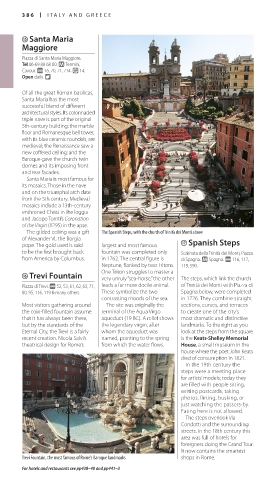
The gilded ceiling was a gift The Spanish Steps, with the church of Trinità dei Monti above
of Alexander VI, the Borgia
pope. The gold used is said largest and most famous u Spanish Steps
to be the first brought back fountain was completed only Scalinata della Trinità dei Monti, Piazza
from America by Columbus. in 1762. The central figure is di Spagna. q Spagna. @ 116, 117,
Neptune, flanked by two Tritons. 119, 590.
y Trevi Fountain One Triton struggles to master a The steps, which link the church
very unruly “sea-horse,” the other
Piazza di Trevi. @ 52, 53, 61, 62, 63, 71, leads a far more docile animal. of Trinità dei Monti with Piazza di
80, 95, 116, 119 & many others. These symbolize the two Spagna below, were completed
contrasting moods of the sea. in 1726. They combine straight
Most visitors gathering around The site was originally the sections, curves, and terraces
the coin-filled fountain assume terminal of the Aqua Virgo to create one of the city’s
that it has always been there, aqueduct (19 BC). A relief shows most dramatic and distinctive
but by the standards of the the legendary virgin, after landmarks. To the right as you
Eternal City, the Trevi is a fairly whom the aqueduct was look at the steps from the square
recent creation. Nicola Salvi’s named, pointing to the spring is the Keats-Shelley Memorial
theatrical design for Rome’s from which the water flows. House, a small museum in the
house where the poet John Keats
died of consumption in 1821.
In the 19th century the
steps were a meeting place
for artists’ models; today they
are filled with people sitting,
writing postcards, taking
photos, flirting, busking, or
just watching the passers-by.
Eating here is not allowed.
The steps overlook Via
Condotti and the surrounding
streets. In the 18th century this
area was full of hotels for
foreigners doing the Grand Tour.
It now contains the smartest
Trevi Fountain, the most famous of Rome’s Baroque landmarks shops in Rome.
For hotels and restaurants see pp438–40 and pp441–3
386-387_EW_Europe.indd 386 14/07/16 10:16 am

