


Page 399 - (DK Eyewitness) Travel Guide - Europe
P. 399
FL ORENCE 397
Michelangelo’s David (1504).
This colossal nude depicts the
biblical hero who killed the
giant Goliath; it established
Michelangelo, then aged 29,
as the foremost sculptor of
his time. The statue was
moved here from the Palazzo
Vecchio in 1873 to protect it
from the elements.
Michelangelo’s other
masterpieces include a statue
of St. Matthew finished in 1508,
and the Quattro Prigioni (four
prisons), sculpted between 1521
and 1523. The muscular figures
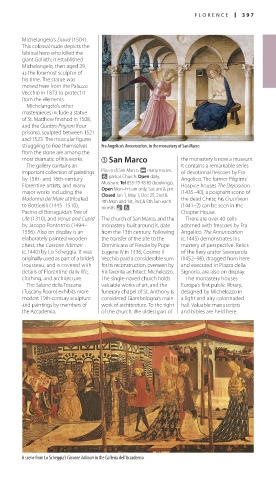
struggling to free themselves Fra Angelico’s Annunciation, in the monastery of San Marco
from the stone are among the
most dramatic of his works. 5 San Marco the monastery is now a museum.
The gallery contains an It contains a remarkable series
important collection of paintings Piazza di San Marco. @ many routes. of devotional frescoes by Fra
by 15th- and 16th-century 7 partial. Church: Open daily. Angelico. The former Pilgrims’
Museum: Tel 055-29 48 83 (bookings).
Florentine artists, and many Open Mon–Fri: am only, Sat: am & pm. Hospice houses The Deposition
major works including the Closed Jan 1, May 1, Dec 25, 2nd & (1435–40), a poignant scene of
Madonna del Mare attributed 4th Mon and 1st, 3rd, & 5th Sun each the dead Christ; his Crucifixion
to Botticelli (1445–1510), month. & 7 (1441–2) can be seen in the
Pacino di Bonaguida’s Tree of Chapter House.
Life (1310), and Venus and Cupid The church of San Marco, and the There are over 40 cells
by Jacopo Pontormo (1494– monastery built around it, date adorned with frescoes by Fra
1556). Also on display is an from the 13th century. Following Angelico. The Annunciation
elaborately painted wooden the transfer of the site to the (c.1445) demonstrates his
chest, the Cassone Adimari Dominicans of Fiesole by Pope mastery of perspective. Relics
(c.1440) by Lo Scheggia. It was Eugene IV in 1436, Cosimo il of the fiery orator Savonarola
originally used as part of a bride’s Vecchio paid a considerable sum (1452–98), dragged from here
trousseau, and is covered with for its reconstruction, overseen by and executed in Piazza della
details of Florentine daily life, his favorite architect, Michelozzo. Signoria, are also on display.
clothing, and architecture. The single-naved church holds The monastery houses
The Salone della Toscana valuable works of art, and the Europe’s first public library,
(Tuscany Room) exhibits more funerary chapel of St. Anthony is designed by Michelozzo in
modest 19th-century sculpture considered Giambologna’s main a light and airy colonnaded
and paintings by members of work of architecture. To the right hall. Valuable manuscripts
the Accademia. of the church, the oldest part of and bibles are held here.
A scene from Lo Scheggia’s Cassone Adimari in the Galleria dell’Accademia
396-397_EW_Europe.indd 397 14/07/16 10:16 am

