


Page 420 - (DK Eyewitness) Travel Guide - Europe
P. 420
418 IT AL Y AND GREECE
2 Doge’s Palace
The official residence of the Venetian ruler
(Doge) was founded in the 9th century. The
present palace owes its external appearance
to the building work of the 14th and early
15th centuries. To create their airy Gothic
masterpiece, the Venetians broke with
tradition by perching the bulk of the palace
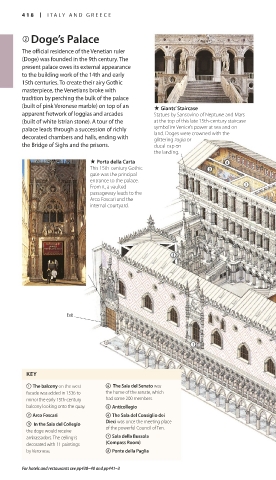
(built of pink Veronese marble) on top of an . Giants’ Staircase
apparent fretwork of loggias and arcades Statues by Sansovino of Neptune and Mars
(built of white Istrian stone). A tour of the at the top of this late 15th-century staircase
palace leads through a succession of richly symbolize Venice’s power at sea and on
land. Doges were crowned with the
decorated chambers and halls, ending with glittering zogia or
the Bridge of Sighs and the prisons. ducal cap on
the landing.
. Porta della Carta
This 15th-century Gothic
gate was the principal
entrance to the palace.
From it, a vaulted
passageway leads to the
Arco Foscari and the
internal courtyard.
Exit
KEY
1 The balcony on the west 4 The Sala del Senato was
facade was added in 1536 to the home of the senate, which
mirror the early 15th-century had some 200 members.
balcony looking onto the quay. 5 Anticollegio
2 Arco Foscari 6 The Sala del Consiglio dei
Dieci was once the meeting place
3 In the Sala del Collegio of the powerful Council of Ten.
the doge would receive
ambassadors. The ceiling is 7 Sala della Bussola
decorated with 11 paintings (Compass Room)
by Veronese. 8 Ponte della Paglia
For hotels and restaurants see pp438–40 and pp441–3
418-419_EW_Europe.indd 418 14/07/16 10:10 am

