


Page 454 - (DK Eyewitness) Travel Guide - Europe
P. 454
452 IT AL Y AND GREECE
2 Monastiráki
q Monastiráki. Market: Open daily.
This lively and atmospheric
area, which is named after
the little monastery in Plateía
Monastirakíou, is synonymous
with Athens’ famous flea
market. Located next to the
ancient Agora, it is bounded
by Sarrí in the west and Aiólou
in the east. The streets of
Pandrósou, Ifaístou, and Areos
leading off Plateía Monastirakíou
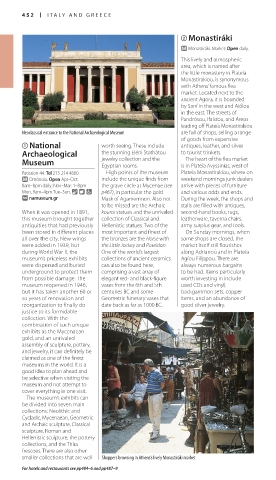
Neoclassical entrance to the National Archaeological Museum are full of shops, selling a range
of goods from expensive
1 National worth seeing. These include antiques, leather, and silver
Archaeological the stunning Eléni Stathátou to tourist trinkets.
Museum jewelry collection and the The heart of the flea market
Egyptian rooms.
is in Plateía Avyssinías, west of
Patissíon 44. Tel 213-214 4800. High points of the museum Plateía Monastirakíou, where on
q Omónoia. Open Apr–Oct: include the unique finds from weekend mornings junk dealers
8am–8pm daily; Nov–Mar: 1–8pm the grave circle at Mycenae (see arrive with pieces of furniture
Mon, 9am–4pm Tue–Sun. & 8 7 p467), in particular the gold and various odds and ends.
∑ namuseum.gr Mask of Agamemnon. Also not During the week, the shops and
to be missed are the Archaic stalls are filled with antiques,
When it was opened in 1891, kouroi statues and the unrivaled second-hand books, rugs,
this museum brought together collection of Classical and leatherware, taverna chairs,
antiquities that had previously Hellenistic statues. Two of the army surplus gear, and tools.
been stored in different places most important and finest of On Sunday mornings, when
all over the city. New wings the bronzes are the Horse with some shops are closed, the
were added in 1939, but the Little Jockey and Poseidon. market itself still flourishes
during World War II, the One of the world’s largest along Adrianoú and in Plateía
museum’s priceless exhibits collections of ancient ceramics Agíou Filíppou. There are
were dispersed and buried can also be found here, always numerous bargains
underground to protect them comprising a vast array of to be had. Items particularly
from possible damage. The elegant red- and black-figure worth investing in include
museum reopened in 1946, vases from the 6th and 5th used CDs and vinyl,
but it has taken another 60 or centuries BC and some backgammon sets, copper
so years of renovation and Geometric funerary vases that items, and an abundance of
reorganization to finally do date back as far as 1000 BC. good silver jewelry.
justice to its formidable
collection. With the
combination of such unique
exhibits as the Mycenaean
gold, and an unrivaled
assembly of sculpture, pottery,
and jewelry, it can definitely be
claimed as one of the finest
museums in the world. It is a
good idea to plan ahead and
be selective when visiting the
museum and not attempt to
cover everything in one visit.
The museum’s exhibits can
be divided into seven main
collections: Neolithic and
Cycladic, Mycenaean, Geometric
and Archaic sculpture, Classical
sculpture, Roman and
Hellenistic sculpture, the pottery
collections, and the Thíra
frescoes. There are also other
smaller collections that are well Shoppers browsing in Athens’s lively Monastiráki market
For hotels and restaurants see pp484–6 and pp487–9
452-453_EW_Europe.indd 452 14/07/16 10:17 am

