


Page 455 - (DK Eyewitness) Travel Guide - Europe
P. 455
A THENS 453
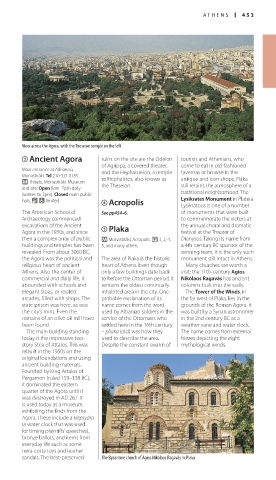
View across the Agora, with the Theseion temple on the left
3 Ancient Agora ruins on the site are the Odeion tourists and Athenians, who
of Agrippa, a covered theater, come to eat in old-fashioned
Main entrance at Adrianoú, and the Hephaisteion, a temple tavernas or browse in the
Monastiráki. Tel 210-321 0185.
q Thiseío, Monastiráki. Museum to Hephaistos, also known as antique and icon shops, Pláka
and site: Open 8am–7pm daily the Theseion. still retains the atmosphere of a
(winter: to 3pm). Closed main public trad i tional neighborhood. The
hols. & 7 limited. 4 Acropolis Lysikrates Monument in Plateía
Lysikrátous is one of a number
The American School of See pp454–6. of monuments that were built
Archaeology commenced to commemorate the victors at
excavations of the Ancient 5 Plaka the annual choral and dramatic
Agora in the 1930s, and since festival at the Theater of
then a complex array of public q Monastiráki, Acropolis. v 1, 2, 4, Dionysos. Taking its name from
buildings and temples has been 5, and many others. a 4th-century BC sponsor of the
revealed. From about 3000 BC, winning team, it is the only such
the Agora was the political and The area of Plaka is the historic monument still intact in Athens.
religious heart of ancient heart of Athens. Even though Many churches are worth a
Athens. Also the center of only a few buildings date back visit: the 11th-century Agios
commercial and daily life, it to before the Ottoman period, it Nikólaos Ragavás has ancient
abounded with schools and remains the oldest continually columns built into the walls.
elegant stoas, or roofed inhabited area in the city. One The Tower of the Winds, in
arcades, filled with shops. The probable explanation of its the far west of Pláka, lies in the
state prison was here, as was name comes from the word grounds of the Roman Agora. It
the city’s mint. Even the used by Albanian soldiers in the was built by a Syrian astronomer
remains of an olive oil mill have service of the Ottomans who in the 2nd century BC as a
been found. settled here in the 16th century weather vane and water clock.
The main building standing – pliaka (old) was how they The name comes from external
today is the impressive two- used to describe the area. friezes depicting the eight
story Stoa of Attalos. This was Despite the constant swarm of mythological winds.
rebuilt in the 1950s on the
original foundations and using
ancient building materials.
Founded by King Attalos of
Pergamon (ruled 159–138 BC),
it dominated the eastern
quarter of the Agora until it
was destroyed in AD 267. It
is used today as a museum,
exhibiting the finds from the
Agora. These include a klepsydra
(a water clock that was used
for timing plaintiffs’ speeches),
bronze ballots, and items from
everyday life such as some
terra-cotta toys and leather
sandals. The best-preserved The Byzantine church of Agios Nikólaos Ragavás in Plaka
452-453_EW_Europe.indd 453 14/07/16 10:17 am

