


Page 498 - (DK Eyewitness) Travel Guide - Europe
P. 498
496 GERM AN Y , A USTRIA , AND SWITZERLAND
The people who eventually inherited the who should grant lands, appoint bishops,
largest kingdom were the Franks, who and collect revenues. Each would try to
conquered France and in the early 9th bribe the Electors (Kurfürsten) – princes
century, under Charlemagne, subdued and bishops who chose the emperor.
most of the German tribes, including The role of the Electors was clarified
the Saxons, Swabians, and in the Golden Bull issued by
Bavarians. The pope gave his Emperor Charles IV in 1356,
blessing to Charlemagne’s but by the 16th century, the
overlord-ship, thus creating position had become the
the Holy Roman Empire. more or less hereditary right
After Charlemagne, the of the Austrian Habsburgs.
German kingdom became The power of the church
separated from the rest of the created many problems and
empire. The next strong German it was no surprise that the
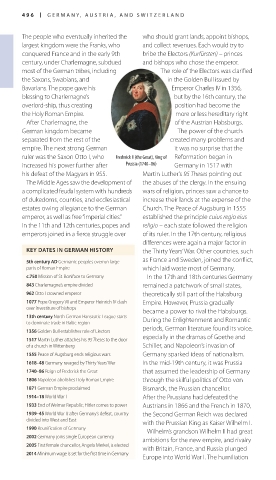
ruler was the Saxon Otto I, who Frederick II (the Great), King of Reformation began in
increased his power further after Prussia (1740–86) Germany in 1517 with
his defeat of the Magyars in 955. Martin Luther’s 95 Theses pointing out
The Middle Ages saw the development of the abuses of the clergy. In the ensuing
a complicated feudal system with hundreds wars of religion, princes saw a chance to
of dukedoms, counties, and ecclesiastical increase their lands at the expense of the
estates owing allegiance to the German Church. The Peace of Augsburg in 1555
emperor, as well as free “imperial cities.” established the principle cuius regio eius
In the 11th and 12th centuries, popes and religio – each state followed the religion
emperors joined in a fierce struggle over of its ruler. In the 17th century, religious
differences were again a major factor in
KEY DATES IN GERMAN HISTORY the Thirty Years’ War. Other countries, such
5th century AD Germanic peoples overrun large as France and Sweden, joined the conflict,
parts of Roman Empire which laid waste most of Germany.
c.750 Mission of St. Boniface to Germany In the 17th and 18th centuries Germany
843 Charlemagne’s empire divided remained a patchwork of small states,
962 Otto I crowned emperor theoretically still part of the Habsburg
1077 Pope Gregory VII and Emperor Heinrich IV clash Empire. However, Prussia gradually
over investiture of bishops became a power to rival the Habsburgs.
13th century North German Hanseatic League starts During the Enlightenment and Romantic
to dominate trade in Baltic region
1356 Golden Bull establishes role of Electors periods, German literature found its voice,
especially in the dramas of Goethe and
1517 Martin Luther attaches his 95 Theses to the door
of a church in Wittenberg Schiller, and Napoleon’s invasion of
1555 Peace of Augsburg ends religious wars Germany sparked ideas of nationalism.
1618–48 Germany ravaged by Thirty Years’ War In the mid-19th century, it was Prussia
1740–86 Reign of Frederick the Great that assumed the leadership of Germany
1806 Napoleon abolishes Holy Roman Empire through the skilful politics of Otto von
1871 German Empire proclaimed Bismarck, the Prussian chancellor.
1914–18 World War I After the Prussians had defeated the
1933 End of Weimar Republic; Hitler comes to power Austrians in 1866 and the French in 1870,
1939–45 World War II: after Germany’s defeat, country the Second German Reich was declared
divided into West and East with the Prussian King as Kaiser Wilhelm I.
1990 Reunification of Germany Wilhelm’s grandson Wilhelm II had great
2002 Germany joins single European currency ambitions for the new empire, and rivalry
2005 First female chancellor, Angela Merkel, is elected with Britain, France, and Russia plunged
2014 Minimum wage is set for the first time in Germany
Europe into World War I. The humiliation
496-497_EW_Europe.indd 496 14/07/16 10:45 am

