


Page 513 - (DK Eyewitness) Travel Guide - Europe
P. 513
BERLIN 511
s Potsdam and Park Sanssouci VISITORS’ CHECKLIST
An independent city close to Berlin, Potsdam has almost Practical Information
160,000 inhabitants and is the capital of Brandenburg. The first Brandenburg. * 160,000.
documented reference to the town dates from AD 993; it was n Brandenburger Straße 3
Tel 0331-27 55 80.
later granted municipal rights in 1317. The town blossomed in ∑ potsdam.de
the 1600s, during the era of the Great Elector, and then again in Transport
the 18th century, when the splendid summer palace, Schloss £ from Bahnhof Zoo, Berlin to
Sanssouci, was built for Frederick the Great. Potsdam suffered Potsdam-Stadt. @ v
badly in World War II, particularly on April 14 and 15, 1945,
when the Allies bombed the town’s center.
P Holländisches Viertel
Friedrich-Ebertstraße/Kurfürstenstr./
Hebbelstr./Gutenbergstr. @ 138, 601,
602, 603, 604 & many others.
The Dutch Quarter features stores,
galleries, cafés, and beer cellars,
especially along Mittelstraße. The
area was built up in the early
1700s, when Dutch workers,
invited by Friedrich Wilhelm I,
began to settle in Potsdam.
Today, you can still see the
pretty red-brick, gabled houses
that were built for them.
P Filmpark Babelsberg
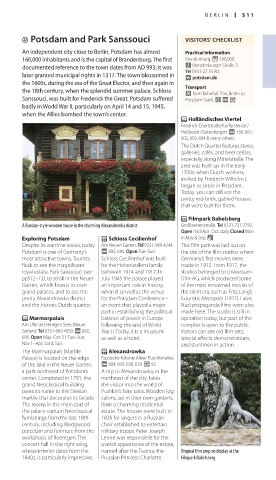
A Russian-style wooden house in the charming Alexandrowka district Großbeerenstraße. Tel 0331-721 2750.
Open mid-Apr–Oct: daily Closed Mon
Exploring Potsdam P Schloss Cecilienhof in May & Sep. &
Despite its wartime losses, today Am Neuen Garten. Tel 0331-969 4244. This film park was laid out on
Potsdam is one of Germany’s @ 692, 695. Open Tue–Sun. the site of the film studios where
most attractive towns. Tourists Schloss Cecilienhof was built Germany’s first movies were
flock to see the magnificent for the Hohenzollern family made in 1912. From 1917, the
royal estate, Park Sanssouci (see between 1914 and 1917. In studios belonged to Universum-
pp512–13), to stroll in the Neuer July 1945 the palace played Film-AG, which produced some
Garten, which boasts its own an important role in history, of the most renowned movies of
grand palaces, and to see the when it served as the venue the silent era, such as Fritz Lang’s
pretty Alexandrowka district for the Potsdam Conference – futuristic Metropolis (1927). Later,
and the historic Dutch quarter. an event that played a major Nazi propaganda films were also
part in establishing the political made here. The studio is still in
P Marmorpalais balance of power in Europe operation today, but part of the
Am Ufer des Heiligen Sees (Neuer following the end of World complex is open to the public.
Garten). Tel 0331-969 4550. @ 692, War II. Today, it is a museum Visitors can see old film sets,
695. Open May–Oct 31: Tue–Sun; as well as a hotel. special effects demonstrations,
Nov 1–Apr: Sat & Sun. and stuntmen in action.
The Marmorpalais (Marble P Alexandrowka
Palace) is located on the edge Russische Kolonie Allee/ Puschkinallee.
of the lake in the Neuer Garten, @ 604, 609, 638, 639. v 92.
a park northeast of Potsdam’s A trip to Alexandrowka, in the
center. Completed in 1791, the northeast of the city, takes
grand Neoclassical building the visitor into the world of
owes its name to the Silesian Pushkin’s fairy tales. Wooden log
marble that decorates its facade. cabins, set in their own gardens,
The rooms in the main part of form a charming residential
the palace contain Neoclassical estate. The houses were built in
furnishings from the late 18th 1826 for singers in a Russian
century, including Wedgwood choir established to entertain
porcelain and furniture from the military troops. Peter Joseph
workshops of Roentgen. The Lenné was responsible for the
concert hall in the right wing, overall appearance of the estate,
whose interior dates from the named after the Tsarina, the Original film prop on display at the
1840s, is particularly impressive. Prussian Princess Charlotte. Filmpark Babelsberg
510-511_EW_Europe.indd 511 14/07/16 10:18 am

