


Page 516 - (DK Eyewitness) Travel Guide - Europe
P. 516
514 GERM AN Y , A USTRIA , AND SWITZERLAND
Eastern Germany
Closed to the West for over 40 years of Communist rule, Eastern
Germany is now fast rebuilding its reputation as an attractive
tourist destination. The powerful duchy of Saxony, whose
rulers were also Electors and, in the early 18th century, kings
of Poland, has left behind a rich cultural heritage for visitors to
explore. After Berlin, the area’s main attractions are Dresden,
the ancient capital of Saxony, the old university town of Leipzig,
and the important cultural center of Weimar in Thuringia.
2 Dresden bombing raids on the city.
Today, meticulous restoration Vermeer’s Girl Reading a Letter,
Saxony. * 535,000. k 15 km work is in progress to return the Gemäldegalerie Alte Meister
(9 miles) N. £ @ 4 n Neumarkt 2, city to its former glory.
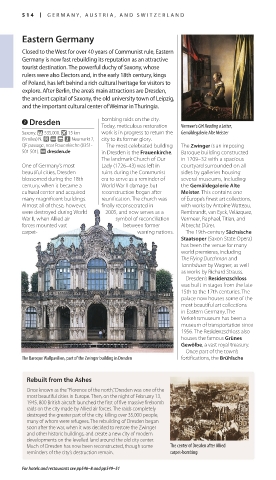
QF passage, near Frauenkirche (0351- The most celebrated building The Zwinger is an imposing
501 501). ∑ dresden.de in Dresden is the Frauenkirche. Baroque building constructed
The landmark Church of Our in 1709–32 with a spacious
One of Germany’s most Lady (1726–43) was left in courtyard surrounded on all
beautiful cities, Dresden ruins during the Communist sides by galleries housing
blossomed during the 18th era to serve as a reminder of several museums, including
century, when it became a World War II damage but the Gemäldegalerie Alte
cultural center and acquired reconstruction began after Meister. This contains one
many magnificent buildings. reunification. The church was of Europe’s finest art collections,
Almost all of these, however, finally reconsecrated in with works by Antoine Watteau,
were destroyed during World 2005, and now serves as a Rembrandt, van Eyck, Velázquez,
War II, when Allied air symbol of reconciliation Vermeer, Raphael, Titian, and
forces mounted vast between former Albrecht Dürer.
carpet- warring nations. The 19th-century Sächsische
Staatsoper (Saxon State Opera)
has been the venue for many
world premieres, including
The Flying Dutchman and
Tannhäuser by Wagner, as well
as works by Richard Strauss.
Dresden’s Residenzschloss
was built in stages from the late
15th to the 17th centuries. The
palace now houses some of the
most beautiful art collections
in Eastern Germany. The
Verkehrsmuseum has been a
museum of transportation since
1956. The Residenzschloss also
houses the famous Grünes
Gewölbe, a vast royal treasury.
Once part of the town’s
The Baroque Wallpavilion, part of the Zwinger building in Dresden fortifications, the Brühlsche
Rebuilt from the Ashes
Once known as the “Florence of the north,” Dresden was one of the
most beautiful cities in Europe. Then, on the night of February 13,
1945, 800 British aircraft launched the first of five massive firebomb
raids on the city made by Allied air forces. The raids completely
destroyed the greater part of the city, killing over 35,000 people,
many of whom were refugees. The rebuilding of Dresden began
soon after the war, when it was decided to restore the Zwinger
and other historic buildings, and create a new city of modern
developments on the levelled land around the old city center.
Much of Dresden has now been reconstructed, though some The center of Dresden after Allied
reminders of the city’s destruction remain. carpet-bombing
For hotels and restaurants see pp546–8 and pp549–51
514-515_EW_Europe.indd 514 14/07/16 10:18 am

