


Page 522 - (DK Eyewitness) Travel Guide - Europe
P. 522
520 GERM AN Y , A USTRIA , AND SWITZERLAND
1 Residenz
The origins of Munich’s grand Residenz – the former
residence of Bavarian kings – go back to the 14th century,
when a castle was built here for the Wittelsbach dynasty. In
the following centuries, the fortress was replaced by a palace
complex, which in turn was gradually modified and extended.
Major work in the 17th century included the construction
of two chapels, the Reiche Kapelle and the Hofkapelle. The
Königsbau, containing the superb Nibelungensäle, was
added by Leo von Klenze in the first half of the 19th century.
Since 1920, the palace has been open to the public as a
museum, displaying a wealth of magnificent treasures. In
addition to the collections of the Residenzmuseum and the
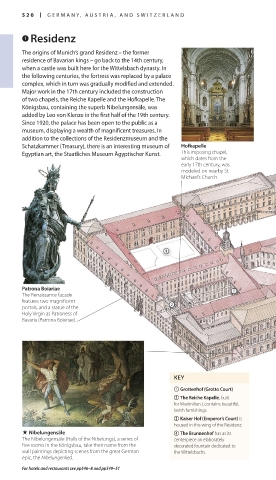
Schatzkammer (Treasury), there is an interesting museum of Hofkapelle
Egyptian art, the Staatliches Museum Ägyptischer Kunst. This imposing chapel,
which dates from the
early 17th century, was
modeled on nearby St.
Michael’s Church.
Patrona Boiariae
The Renaissance facade
features two magnificent
portals, and a statue of the
Holy Virgin as Patroness of
Bavaria (Patrona Boiariae).
KEY
1 Grottenhof (Grotto Court)
2 The Reiche Kapelle, built
for Maximilian I, contains beautiful,
lavish furnishings.
3 Kaiser Hof (Emperor’s Court) is
housed in this wing of the Residenz.
. Nibelungensäle 4 The Brunnenhof has as its
The Nibelungensäle (Halls of the Nibelungs), a series of centerpiece an elaborately
five rooms in the Königsbau, take their name from the decorated fountain dedicated to
wall paintings depicting scenes from the great German the Wittelsbachs.
epic, the Nibelungenlied.
For hotels and restaurants see pp546–8 and pp549–51
520-521_EW_Europe.indd 520 14/07/16 10:18 am

