


Page 525 - (DK Eyewitness) Travel Guide - Europe
P. 525
MUNICH 523
and Egid Quirin Asam, who built Temple of Aphaia on the Greek
it as a private family church. island of Aegina. The museum’s
Completed in 1746, the tiny imposing facade, with the
church is a riot of decoration portico of an Ionic temple at
with a dynamically shaped the center, is part of a kind of
single nave, where no surface is Neoclassical forum created in
left unembellished. The eye is the first half of the 19th century
drawn to the altar, and its to house the archaeological
sculptural group of the Holy finds acquired by King Ludwig I
Trinity. The house next door to of Bavaria. On the opposite side
the church was the residence of the square, the Staatliche
of Egid Quirin Asam, who was Antikensammlung houses
a stuccoist and sculptor. From smaller treasures, in particular
one of the windows of his a vast array of Greek vases. Four Apostles (1526) by Albrecht Dürer, in
house, he could see the altar. the Alte Pinakothek
7 Alte Pinakothek St. Luke Painting the Madonna
by Rogier van der Weyden,
Barer Straße 27. Tel 089-23 80 52 16.
Königsplatz. v 27. @ 100. Open and works by Hans Memling
Tue–Sun (parts of museum closed for and Pieter Brueghel the Elder.
renovations until 2018). & 7 Of later artists, the one with
most works on display is the
This magnificent gallery is filled prolific Rubens. There are also
with masterpieces of European interesting works by El Greco,
art from the Middle Ages to the Rembrandt, Raphael, Titian,
mid-18th century. Many of the and Tintoretto.
Wittelsbach rulers of Bavaria
were great collectors, the first
being Wilhelm IV the Steadfast, 8 Neue Pinakothek
who ruled from 1508 to 1550. Barer Straße 29. Tel 089-23 80 51 95.
The Alte Pinakothek (Old Picture Theresienstraße. v 27. @ 100.
Gallery) was built for Ludwig I Open Wed–Mon. &
by Leo von Klenze in 1826–36
in the form of a Florentine Bavaria’s collection of late 18th-
Renaissance palazzo. The ground and 19th-century European
floor is devoted to the works of painting and sculpture occupies
German and Flemish Old Masters a purpose-built gallery
The richly decorated altar of the from the 16th and 17th centuries. completed in 1981. German
Rococo Asamkirche On the first floor are works by painting of every artistic
Dutch, Flemish, French, German, movement of the 19th century,
6 Glyptothek Italian, and Spanish artists. including Romanticism, the
Of the German works, pride of “Nazarenes,” German and
Königsplatz 3. Tel 089-28 61 00. place goes to Albrecht Dürer’s Austrian Biedermeier, and
Königsplatz. Open Tue–Sun. famous Self-Portrait (1500) and Impressionism is well
& Staatliche Antikensammlung: two panels of an altarpiece represented. There are also
Königsplatz 1. Tel 089-59 98 88 30. showing Four Apostles. Among works by French Realists,
Open Tue–Sun. & the other German artists Impressionists, and Symbolists
represented are Lucas Cranach purchased when the gallery’s
On the northern side of the Elder and Grünewald. Early director was the art historian
Königsplatz stands the Flemish masterpieces include Hugo von Tschudi.
Glyptothek, a collection of The open space between
Greek and Roman sculpture, the Neue and Alte Pinakothek
notably statues from the has been turned into a
sculpture park.
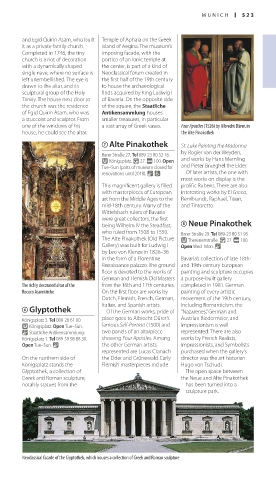
Neoclassical facade of the Glyptothek, which houses a collection of Greek and Roman sculpture
522-523_EW_Europe.indd 523 14/07/16 10:18 am

