


Page 586 - (DK Eyewitness) Travel Guide - Europe
P. 586
584 GERM AN Y , A USTRIA , AND SWITZERLAND
The Alps
The Alps are one of the oldest mountain ranges in the world,
formed 65 million years ago when the Eurasian and African
tectonic plates collided. They dominate Switzerland’s
landscape, covering more than half its surface area, and have
shaped its history and economy. Switzerland is home to many
well-known, distinctive peaks – such as the Matterhorn,
Jungfrau, and Eiger – which were early tourist attractions in
the 18th and 19th centuries. Trade and pilgrimage routes
have crossed the Alps since Roman times, but it is only in
the last century that this wild and beautiful landscape has
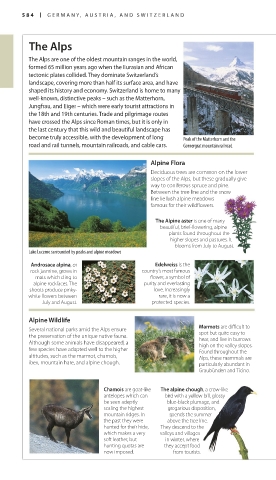
become truly accessible, with the development of long Peak of the Matterhorn and the
road and rail tunnels, mountain railroads, and cable cars. Gornergrat mountain railroad
Alpine Flora
Deciduous trees are common on the lower
slopes of the Alps, but these gradually give
way to coniferous spruce and pine.
Between the tree line and the snow
line lie lush alpine meadows
famous for their wildflowers.
The Alpine aster is one of many
beautiful, brief-flowering, alpine
plants found throughout the
higher slopes and pastures. It
blooms from July to August.
Lake Lucerne surrounded by peaks and alpine meadows
Androsace alpina, or Edelweiss is the
rock jasmine, grows in country’s most famous
mats which cling to flower, a symbol of
alpine rockfaces. The purity and everlasting
shoots produce pinky- love. Increasingly
white flowers between rare, it is now a
July and August. protected species.
Alpine Wildlife
Several national parks amid the Alps ensure Marmots are difficult to
the preservation of the unique native fauna. spot but quite easy to
hear, and live in burrows
Although some animals have disappeared, a high on the valley slopes.
few species have adapted well to the higher Found throughout the
altitudes, such as the marmot, chamois, Alps, these mammals are
ibex, mountain hare, and alpine chough. particularly abundant in
Graubünden and Ticino.
Chamois are goat-like The alpine chough, a crow-like
antelopes which can bird with a yellow bill, glossy
be seen adeptly blue-black plumage, and
scaling the highest gregarious disposition,
mountain ridges. In spends the summer
the past they were above the tree line.
hunted for their hide, They descend to the
which makes a very valleys and villages
soft leather, but in winter, where
hunting quotas are they accept food
now imposed. from tourists.
584-585_EW_Europe.indd 584 14/07/16 10:19 am

