


Page 62 - (DK Eyewitness) Travel Guide - Europe
P. 62
60 BRIT AIN AND IRELAND
0 British Museum
Middle East
The oldest public museum in the world, the British Museum Numerous galleries at the
was established in 1753 to house the collections of the museum are devoted to the
physician Sir Hans Sloane (1660–1753). Sloane’s artifacts have Middle Eastern collections,
been added to by gifts and purchases from all over the world, covering 7,000 years of history.
The most famous items are the
and the museum now contains innumerable items stretching 7th-century BC Assyrian reliefs
from the present day to prehistory. Robert Smirke designed from King Ashurbanipal’s palace
the main part of the building (1823–50), but the architectural at Nineveh, but of equal interest
highlight is the modern Great Court, with its remarkable roof. are two large human-headed
The 94 galleries which run for more than 4 km (2 miles), cover bulls from 7th-century BC
Khorsabad, and an inscribed
civilizations from ancient Assyria to modern Japan.
Black Obelisk of Assyrian King
Shalmaneser III. Rooms 51–59,
on the upper floor, contain
pieces from ancient Sumeria,
Prehistoric and part of the Oxus Treasure (which
Roman Britain lay buried for over 2,000 years),
Relics of prehistoric Britain are and the museum’s collection
on display in this collection. The of clay cuneiform tablets. The
most impressive items include earliest of these are inscribed
the Mold gold cape made from with the oldest known
a sheet of decorated gold; an pictographs (c.3300 BC).
antlered headdress worn by
hunter-gatherers some 9,000 Ancient Egypt
years ago; and “Lindow Man,” a
1st-century AD sacrificial victim Egyptian sculptures can be
who lay preserved in a bog until found in Room 4 on the main
1984. Some superb Celtic floor. These include a fine red
metalwork is also on show, granite head of a king, thought
alongside the silver Mildenhall Reconstruction of the ceremonial helmet to be Amenophis III, and a
Treasure and other notable found at Sutton Hoo colossal statue of king Ramses II.
Roman pieces. The Hinton St. Also on show is the Rosetta
Mary mosaic (4th century AD) the famous 12th-century Lewis Stone, which was used by
features a roundel containing chessmen and a gold enameled Jean-Franćois Champollion
the earliest known British reliquary of the Holy Thorn (1790–1832) as a primer for
depiction of Christ. (Christ’s Crown of Thorns), deciphering Egyptian
dating from the 15th century hieroglyphs. An extraordinary
and said to have belonged to array of mummies, jewelry, and
Medieval, Renaissance, Jean, duc de Berry. Another Coptic art can also be found in
and Modern Objects
highlight is a Byzantine icon rooms 61–66 upstairs, including
The spectacular Sutton Hoo painted on a wooden tablet. a famous bronze cat with a gold
ship treasure, the burial hoard The museum’s modern nose-ring. The various
of a 7th-century Anglo-Saxon collection includes Wedgwood instruments used by embalmers
king, is on display in Room 41. pottery, glassware, and a series to preserve bodies before
This superb find, unearthed in of Russian revolutionary plates. entombment are all displayed.
Woodbridge, near Suffolk, in
1939, revolutionized scholars’
understanding of Anglo-Saxon
life and ritual. The artifacts
uncovered include a helmet
and shield, Celtic hanging
bowls, the remains of a lyre,
and gold and garnet jewelry.
Adjacent galleries contain
a collection of clocks and
watches. Some exquisite
timepieces are on view here,
including an over 400-year-old
clock from Prague, designed as
a model galleon; in its day, it
pitched, played music, and even
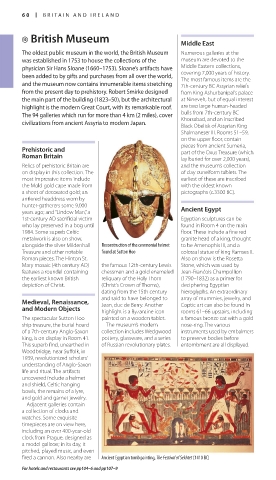
fired a cannon. Also nearby are Ancient Egyptian tomb painting, The Festival of Sekhtet (1410 BC)
For hotels and restaurants see pp104–6 and pp107–9
060-061_EW_Europe.indd 60 14/07/16 10:12 am

