


Page 66 - (DK Eyewitness) Travel Guide - Europe
P. 66
64 BRIT AIN AND IRELAND
experiment with aeronautical meet its future energy needs
concepts. through games and hands-on
“The Exploration of Space” exhibits. Our understanding of
exhibits the scarred Apollo 10 human identity is the subject
spacecraft which carried three of “Who Am I?,” where visitors
astronauts to the moon and can learn about genetics and
back in May 1969. There is also current biomedical discoveries.
a video of the Apollo 11 moon The wing also contains an
landing a few weeks later. IMAX® cinema, a 4D motion-
The “Making the Modern effects theater, and a café.
World” gallery displays objects
that have shaped the world as
Children exploring the “Pattern Pod” at the we know it. Among them are t Natural History
Science Museum Stephenson’s Rocket, the most Museum
advanced steam locomotive of
r Science Museum its day, and Crick and Watson’s Cromwell Rd SW7. 1 South
DNA model. Kensington. @ 14, 49, 70, 74, 345,
Exhibition Rd SW7. 1 South 360, 414, 430, C1. Tel 020-7942 5000.
Kensington. @ 14, 49, 70, 74, 345, Other popular sections Open 10am–5:50pm daily. Closed
360, 414, 430, C1. Tel 0870-870 4868. include “Optics,” which has Dec 24–26. 8 7 ∑ nhm.ac.uk
Open 10am–6pm daily. Closed Dec holograms, lasers, and
24–26. & for special exhibitions only. colormixing experiments, and
7 ∑ sciencemuseum.org.uk “Power and Land Transport,” This vast building, designed by
which displays working steam Alfred Waterhouse, is the most
Centuries of scientific and engines, vintage trains, cars, architecturally flamboyant of
technological development and motorbikes. the South Kensington
are illustrated and explained The Wellcome museums. Its richly
at the Science Museum – from Wing is devoted to sculpted stonework
Ancient Greek and Roman contemporary conceals an iron and
medicine to space exploration science and steel frame. This
and nuclear fission. technology. building
The massive and impressive “Antenna” is a technique was
collection, exhibited on five constantly revolutionary
floors, includes steam engines, updated when the museum
spacecraft, and early mechan- exhibition devoted to first opened in 1881.
ical computers. The museum the latest scientific The imaginative displays
aims to bring entertainment to breakthroughs. tackle fundamental
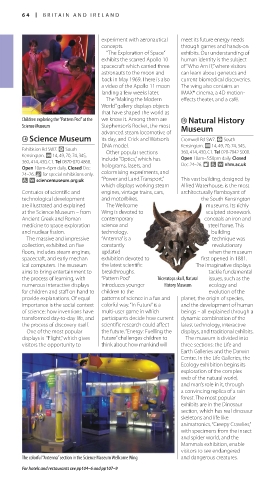
the process of learning, with “Pattern Pod” Triceratops skull, Natural issues, such as the
numerous interactive displays introduces younger History Museum ecology and
for children and staff on hand to children to the evolution of the
provide explanations. Of equal patterns of science in a fun and planet, the origin of species,
importance is the social context colorful way. “In Future” is a and the development of human
of science: how inventions have multi-user game in which beings – all explained through a
transformed day-to-day life, and participants decide how current dynamic combination of the
the process of discovery itself. scientific research could affect latest technology, interactive
One of the most popular the future. “Energy: Fuelling the displays, and traditional exhibits.
displays is “Flight,” which gives Future” challenges children to The museum is divided into
visitors the opportunity to think about how mankind will three sections: the Life and
Earth Galleries and the Darwin
Centre. In the Life Galleries, the
Ecology exhibition begins its
exploration of the complex
web of the natural world,
and man’s role in it, through
a convincing replica of a rain
forest. The most popular
exhibits are in the Dinosaur
section, which has real dinosaur
skeletons and life like
animatronics. “Creepy Crawlies,”
with specimens from the insect
and spider world, and the
Mammals exhibition, enable
visitors to see endangered
The colorful “Antenna” section in the Science Museum Wellcome Wing and dangerous creatures.
For hotels and restaurants see pp104–6 and pp107–9
064-065_EW_Europe.indd 64 14/07/16 10:12 am

