


Page 629 - (DK Eyewitness) Travel Guide - Europe
P. 629
OSL O 627
The Vikings
From the 8th to the 11th century, the Vikings, or Northmen, sailed from their
overpopulated fjords in Scandinavia and made their way across Europe, plundering,
looking for trade, and offering mercenary service. The Swedes (or Varangians) established
themselves throughout the Baltic and controlled the overland route to the Black Sea,
while the Danes invaded parts of England, Portugal, and France. The Norwegians,
however, were unparalleled in their success, and their adventures became the stuff of
Viking legend. After overrunning the Orkneys, the Shetlands, the Hebrides, and parts of
Ireland, the Norwegians established colonies in the Faroes, Iceland, and Greenland. They
even sailed to the coast of North America. The Vikings were undoubtedly the most feared
Europeans of their day, and their impact on history was immense. Fear of the Viking raid
unified many otherwise disparate tribes and kingdoms, and many new political states
were created by the Vikings themselves. Despite profiting from the spoils of war, it was
their success as settlers and traders that was the Vikings’ greatest achievement.
Viking religion was dominated by the
supreme gods Odin (god of war), Thor
(thunder), and Frey (fertility). Valhalla
was their equivalent of heaven. Warriors
were buried with whatever it was thought
the afterlife required, and the rich were
entombed in ships, often with their
servants. Most had converted to
Christianity by the late 10th century,
but Sweden remained pagan well
into the 11th century.
Burial “ships” made of stone for warriors from poorer families, Frey, god of
near Aalborg in Denmark fertility
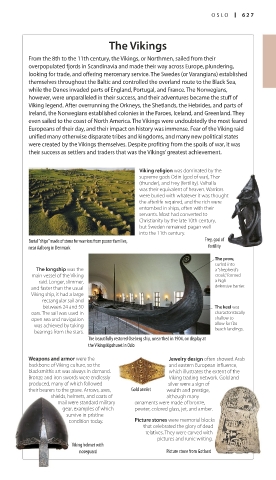
The prow,
curled into
The longship was the a “shepherd’s
main vessel of the Viking crook,” formed
raid. Longer, slimmer, a high
and faster than the usual defensive barrier.
Viking ship, it had a large
rectangular sail and
between 24 and 50 The keel was
oars. The sail was used in characteristically
open sea and navigation shallow to
was achieved by taking allow for flat
beach landings.
bearings from the stars.
The beautifully restored Oseberg ship, unearthed in 1904, on display at
the Vikingskipshuset in Oslo
Weapons and armor were the Jewelry design often showed Arab
backbone of Viking culture, so the and eastern European influence,
blacksmith’s art was always in demand. which illustrates the extent of the
Bronze and iron swords were endlessly Viking trading network. Gold and
produced, many of which followed silver were a sign of
their bearers to the grave. Arrows, axes, Gold armlet wealth and prestige,
shields, helmets, and coats of although many
mail were stan dard military ornaments were made of bronze,
gear, examples of which pewter, colored glass, jet, and amber.
survive in pristine
condition today. Picture stones were memorial blocks
that celebrated the glory of dead
relatives. They were carved with
pictures and runic writing.
Viking helmet with
noseguard Picture stone from Gotland
626-627_EW_Europe.indd 627 14/07/16 10:19 am

