


Page 643 - (DK Eyewitness) Travel Guide - Europe
P. 643
C OPENHA GEN 641
early 20th century, and it is
possible to visit the Royal
Reception Rooms, the Harness
Room, the Stables and Coach
House, and some ruins from the
original fortress.
Above the riding stables is
the Royal Court Theater, built
by Christian VI in 1767. Now
a museum, much of it has
been restored to its original
18th-century appearance.
Exhibits illustrate the history
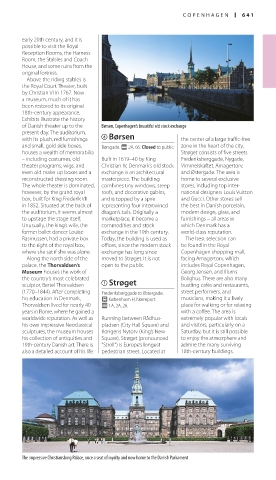
of Danish theater up to the Børsen, Copenhagen’s beautiful old stock exchange
present day. The auditorium,
with its plush, red furnishings 6 Børsen the center of a large traffic-free
and small, gold side boxes, Børsgade. @ 2A, 66. Closed to public. zone in the heart of the city,
houses a wealth of memorabilia Strøget consists of five streets –
– including costumes, old Built in 1619–40 by King Frederiksberggade, Nygade,
theater programs, wigs, and Christian IV, Denmark’s old stock Vimmelskaftet, Amagertorv,
even old make-up boxes and a exchange is an architectural and Østergade. The area is
reconstructed dressing room. masterpiece. The building home to several exclusive
The whole theater is dominated, combines tiny windows, steep stores, including top inter-
however, by the grand royal roofs, and decorative gables, national designers Louis Vuitton
box, built for King Frederik VII and is topped by a spire and Gucci. Other stores sell
in 1852. Situated at the back of representing four intertwined the best in Danish porcelain,
the auditorium, it seems almost dragon’s tails. Originally a modern design, glass, and
to upstage the stage itself. marketplace, it became a furnishings – all areas in
Unusually, the king’s wife, the commodities and stock which Denmark has a
former ballet dancer Louise exchange in the 19th century. world-class reputation.
Rasmussen, had a private box Today, the building is used as The best selection can
to the right of the royal box, offices, since the modern stock be found in the Royal
where she sat if she was alone. exchange has long since Copenhagen shopping mall,
Along the north side of the moved to Strøget. It is not facing Amagertorv, which
palace, the Thorvaldsen’s open to the public. includes Royal Copenhagen,
Museum houses the work of Georg Jensen, and Illums
the country’s most celebrated Bolighus. There are also many
sculptor, Bertel Thorvaldsen 7 Strøget bustling cafés and restaurants,
(1770–1844). After completing Frederiksberggade to Østergade. street performers, and
his education in Denmark, £ København H, Nørreport. musicians, making it a lively
Thorvaldsen lived for nearly 40 @ 1A, 2A, 26. place for walking or for relaxing
years in Rome, where he gained a with a coffee. The area is
worldwide reputation. As well as Running between Rådhus- extremely popular with locals
his own impressive Neoclassical pladsen (City Hall Square) and and visitors, particularly on a
sculptures, the museum houses Kongens Nytorv (King’s New Saturday, but it is still possible
his collection of antiquities and Square), Strøget (pronounced to enjoy the atmosphere and
19th-century Danish art. There is “Stroll”) is Europe’s longest admire the many surviving
also a detailed account of his life. pedestrian street. Located at 18th-century buildings.
The impressive Christiansborg Palace, once a seat of royalty and now home to the Danish Parliament
640-641_EW_Europe.indd 641 14/07/16 10:19 am

