


Page 676 - (DK Eyewitness) Travel Guide - Europe
P. 676
674 CENTR AL AND EASTERN EUROPE
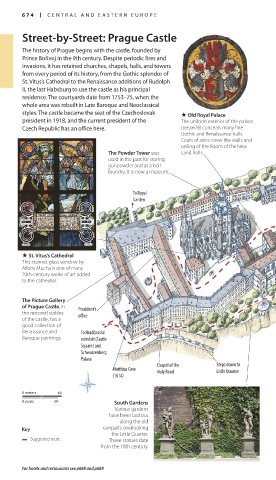
Street-by-Street: Prague Castle
The history of Prague begins with the castle, founded by
Prince Bořivoj in the 9th century. Despite periodic fires and
invasions, it has retained churches, chapels, halls, and towers
from every period of its history, from the Gothic splendor of
St. Vitus’s Cathedral to the Renaissance additions of Rudolph
II, the last Habsburg to use the castle as his principal
residence. The courtyards date from 1753–75, when the
whole area was rebuilt in Late Baroque and Neoclassical
styles. The castle became the seat of the Czechoslovak . Old Royal Palace
president in 1918, and the current president of the The uniform exterior of the palace
Czech Republic has an office here. (see p676) conceals many fine
Gothic and Renaissance halls.
Coats of arms cover the walls and
ceiling of the Room of the New
The Powder Tower was Land Rolls.
used in the past for storing
gunpowder and as a bell
foundry. It is now a museum.
To Royal
Garden
K Á
J I Ř S
. St. Vitus’s Cathedral
This stained-glass window by
Alfons Mucha is one of many
20th-century works of art added
to the cathedral.
The Picture Gallery
of Prague Castle, in President’s
the restored stables office
of the castle, has a
good collection of
Renaissance and To Hradčanské
Baroque paintings. náměstí (Castle
Square) and
Schwarzenberg
Palace
Chapel of the Steps down to
Matthias Gate Holy Rood Little Quarter
(1614)
0 meters 60
0 yards 60 South Gardens
Various gardens
have been laid out
along the old
Key ramparts overlooking
the Little Quarter.
Suggested route These statues date
from the 18th century.
For hotels and restaurants see p688 and p689
674-675_EW_Europe.indd 674 14/07/16 10:20 am

