


Page 103 - How It Works - Book of Amazing Answers To Curious Questions, 12
P. 103
��e ----------�
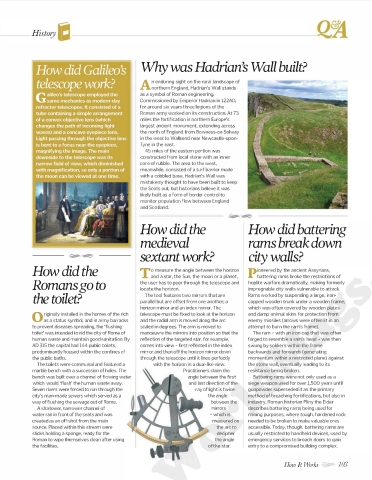
Why was Hadrian's Wall built?
n enduring sight on the rural landscape of
A northern England, Hadrian's Wall stands
as a symbol of Roman engineering.
Commissioned by Emperor Hadrian in 122AD,
for around six years three legions of the
Roman army worked on its construction. At 73
miles the fortification is northern Europe's
largest ancient monument, extending across
the north of England from Bowness-on-Solway
in the west to Wallsend near Newcastle-upon
Tyne in the east.
45 miles of the eastern portion was
constructed from local stone with an inner
core of rubble. The area to the west,
meanwhile, consisted of a turf barrier made
with a cobbled base. Hadrian's Wall was
mistakenly thought to have been built to keep
the Scots out, but historians believe it was
likely built as a form of border control to
monitor population flow between England
and Scotland.
How did the How did battering
medieval rams break down
sextant work? city walls?
How did the o measure the angle between the horizon ioneered by the ancient Assyrians,
Romans go to Tand a star, the Sun, the moon or a planet, Pbattering rams broke the restrictions of
the user has to peer through the telescope and
hoplite warfare dramatically, making formerly
locate the horizon.
impregnable city walls vulnerable to attack.
the toilet? parallel but are offset from one another; a Rams worked by suspending a large, iron
The tool features two mirrors that are
capped wooden trunk under a wooden frame,
horizon mirror and an index mirror. The which was often covered by wooden plates
0 riginally installed in the homes of the rich telescope must be fixed to look at the horizon and damp animal skins for protection from
as a status symbol, and in army barracks and the radial arm is moved along the arc enemy missiles (arrows were often lit in an
to prevent diseases spreading, the 'flushing scaled in degrees. The arm is moved to attempt to burn the ram's frame).
toilet' was intended to rid the city of Rome of manoeuvre the mirrors into position so that the The ram - with an iron cap that was often
human waste and maintain good sanitation. By reflection of the targeted star, for example, forged to resemble a ram's head - was then
AD 315 the capital had 144 public toilets, comes into view - first reflected in the index swung by soldiers within the frame
predominantly housed within the confines of mirror and then off the horizon mirror down backwards and forwards (generating
the public baths. through the telescope until it lines perfectly momentum within a restricted plane) against
The toilets were communal and featured a with the horizon in a dual-like view. the stone wall, eventually leading to its
marble bench with a succession of holes. The Practitioners claim the resistance being broken.
bench was built over a channel of flowing water angle between the first Battering rams were not only used as a
which would 'flush' the human waste away. and last direction of the siege weapon used for over 1,500 years until
Seven rivers were forced to run through the ray of light is twice gunpowder superseded it as the primary
city's man-made sewers which served as a the angle method of breaching fortifications, but also in
way of flushing the sewage out of Rome. between the industry. Roman historian Pliny the Elder
A shallower, narrower channel of mirrors describes battering rams being used for
water ran in front of the seats and was -which is mining purposes, where tough, hardened rock
created as an off-shot from the main measured on needed to be broken to make valuable ores
source. Placed within this stream were the arc to accessible. Today, though, battering rams are
sticks holding a sponge, ready for the decipher usually restricted to handheld devices, used by
Roman to wipe themselves clean after using the angle emergency services to breach doors to gain
the facilities. ofthe star. entry to a compromised building complex.
WorldMags.net How It Works 103
WorldMags.net

