


Page 122 - How It Works - Book of Amazing Answers To Curious Questions, 12
P. 122
�  AMAZIG ANSWERS TO CURIOUS QUESTIONS


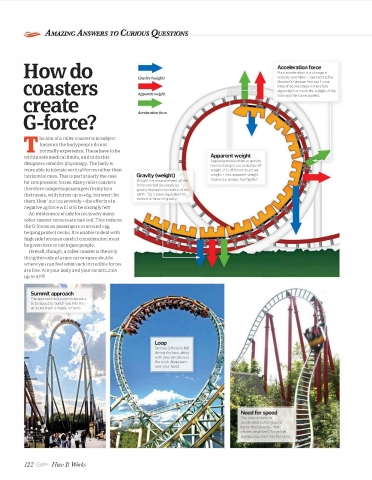
                                                                                          Acceleration force
         How do                                                                           Pure acceleration is a change in
                                                                                          velocity over time - represented by
                                             Gravity (weight)
                                                                                          Newton's famous formula F=ma.
                                                 -
         coasters                            Apparent weight                              Rate of acceleration is therefore
                                                                                          dependent on both the weight of the
                                                                                          train and the force applied.
         create                              Acceleration force
         G-force?

              he aim of a roller coaster is to subject
              forces on the body people do not
         T normally experience. These have to be
         within safe medical limits, and to do this                 Apparent weight
                                                                    Applying acceleration or gravity
         designers consider physiology. The body is
                                                                    forces changes our sensation of
         more able to tolerate vertical forces rather than          weight. It is different to actual
         horizontal ones. This is particularly the case   Gravity (weight)   weight - less apparent weight
                                                                    makes our bodies feel 'lighter'.
         for compression forces. Many roller coasters   Weight is a measurement of the
                                             force exerted on a body by
         therefore compress passengers firmly into   gravity towards the centre of the
         their seats, with forces up to +6g, but won't let   earth. '2g' means equivalent to
                                             twice the force of gravity.
         them 'float' out too severely- the effects of a
         negative zg force will still be strongly felt!
          An intolerance of side forces is why many
         roller coaster corners are banked. This reduces
         the G-forces on passengers to around 1.5g,
         helping protect necks. It is unable to deal with
         high side forces so careful consideration must
         be given here to not injure people.
          Overall, though, a roller coaster is the only
         thing this side of a race car or space shuttle
         where you can feel what such incredible forces
         are like. Are your body and your constitution
         up to it?

           Summit approach
           The approach to a summit appears
           to be about to  launch you into the
           air as no track is visible in front!


                                                                              accelerated to the ground
                                                                              faster than gravity - this
                                                                              causes negative G-force that
                                                                              presses you back into the seat.


         122     How It  TM!rks                 WorldMags.net
                                                WorldMags.net

