


Page 125 - How It Works - Book of Amazing Answers To Curious Questions, 12
P. 125
It's all made
            How do satnavs                                                           possible by satellites

                                                                                     orbiting the Earth at
           lmowwhere you are?  over 8,ooomph ...

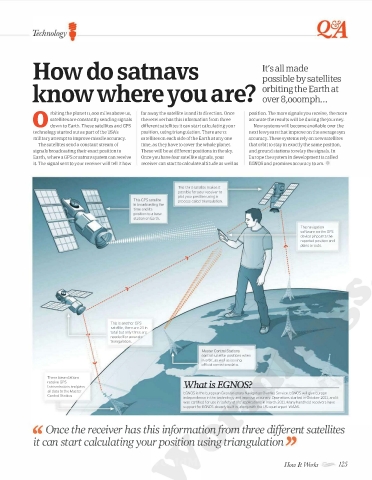
            0 rbiting the planet n,ooo miles above us,   far away the satellite is and its direction. Once   position. The more signa Is you receive, the more
                 satellites are constantly sending signals   the receiver has this information from three   accurate the results will be during the journey.
                 down to Earth. These satellites and GPS   different satellites it can start calculating your   New systems will become available over the
            technology started out as part of the USA's   position, using triangulation. There are 12   next few years that improve on the average 15m
            military attempt to improve missile accuracy.   satellites on each side ofthe Earth at any one   accuracy. These systems rely on new satellites
             The satellites send a constant stream of   time, as they have to cover the whole planet.   that orbit to stay in exactly the same position,
            signals broadcasting their exact position to   These will be at different positions in the sky.   and ground stations to relay the signals. In
            Earth, where a GPS or satnav system can receive   Once you have four satellite signals, your   Europe the system in development is called
            it. The signal sent to your receiver will tell it how   receiver can start to calculate altitude as well as   EGNOS and promises accuracy to 2m.


                                                          This third satellite makes it
                                                          possible for your receiver to
                                                          plot your position using a
                                                          process called triangulation.


                                                                                                 The navigation
                                                                                                 software on the GPS
                                                                                            .    device pinpoints the
                                                                                            .    reported position and
                                                                                            .
                                                                                            "\'   plans a route.
                                                                                             '
                                                                                             '


                            '
                            .
                                    This is another GPS
                            '
                                    satellite, there are 24 in
                                    total but only three are
                            .y
                                    needed for accurate
                             '      triangulation .
                              .
                              '
                              '
                               .                                  control satellite positions when
                               '
                                                                  in orbit, as well as issuing
                                                                  official correction data.
                These base stations
                receive GPS
                transmissions and pass
                all data to the Master                      EGNOS is the European Geostationary Navigation Overlay Service. EGNOS will give Europe
                Control Station.                            independence in the technology and improve accuracy. Operations started in October 2011, and it
                        /                                   was certified for use in 'safety of life' applications in March 2011. Many handheld receivers have
                                                            support for EGNOS already built in, along with the US counterpart WAAS.
                      /
            '' Once the receiver has this information from three different satellites
            it can start calculating your position using triangulation ''


                                                WorldMags.net
                                                WorldMags.net                               How It  Works    125

