


Page 142 - How It Works - Book of Amazing Answers To Curious Questions, 12
P. 142
�  AMAZIG ANSWERS TO CURIOUS QUESTIONS -------------------


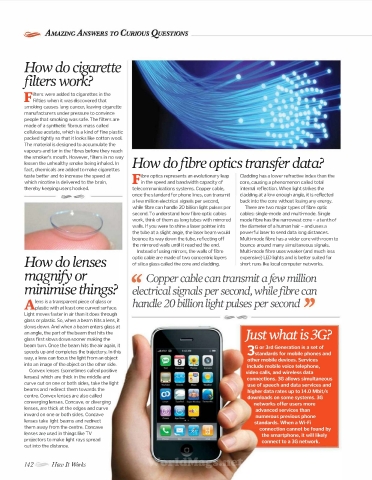
         How do cigarette
        filters work?


            ilters were added to cigarettes  in the
         FFifties when it was discovered that
         smoking  causes  lung cancer,  leaving cigarette
         manufacturers under pressure to convince
         people that smoking was safe. The filters are
         made of a synthetic fibrous  mass called
         cellulose acetate, which is a kind of fine plastic
         packed tightly so that it looks like cotton wool.
         The material is designed to accumulate the
         vapours and tar in the fibres  before they reach
         the smoker's mouth. However, filters in no way
         lessen the unhealthy smoke  being inhaled. In   How do fibre optics transfer data?
         fact, chemicals are added to make cigarettes
         taste better and to increase the speed at   ibre optics represents an  evolutionary leap   Cladding has a lower refractive index than the
         which nicotine is delivered to the  brain,   F in the speed and bandwidth capacity of   core, causing a phenomenon called total
         thereby keeping users hooked.     telecommunications systems. Copper cable,   internal  reflection. When light strikes the
                                           once the standard for phone lines, can transmit   cladding at a low enough angle, it is reflected
                    �<=a
                                           a few million electrical signals per second,   back into the core without  losing any energy.
                                           while fibre can handle 20 billion light pulses per   There are two major types of fibre  optic
                                           second. To understand how fibre optic cables   cables: single-mode and  multi-mode. Single
                                           work, think of them as long tubes with mirrored   mode fibre has the narrowest core - a tenth of
                                           walls. If you were to shine a laser pointer into   the diameter of a human hair - and uses a
                                           the tube at a slight angle, the laser beam would   powerful laser to send data long distances.
                                           bounce its way down the tube, reflecting off   Multi·mode fibre has a wider core with room to
                                           the  mirrored walls until it reached the end.   bounce around  many simultaneous signals.
                                             Instead of using mirrors, the walls of fibre   Multi-mode fibre uses weaker (and much less
         How do lenses                     optic cable are made of two concentric layers   expensive) LED lights and is better suited for
                                           of silica glass called the core and cladding.
                                                                              short runs like  local computer networks.
         magnify or                        ''  Copper cable can transmit a few million

         minimise things?  electrical signals per second, while fzbre can

         J\ lens is a transparent piece of glass or   handle 20 billion light pulses per second ''
         ..l"lastic with at least one curved surface.
         Light moves faster in air than it does through
         glass or plastic. So, when a beam hits a lens, it
         slows down. And when a beam enters glass at
         an angle, the part of the beam that hits the
         glass first slows down sooner making the
         beam turn. Once the beam hits the air again, it
         speeds up and completes the trajectory. In this
         way, a lens can focus the light from an object
         into an image of the object on the other side.
          Convex  lenses  (sometimes called positive
         lenses) which  are thick  in the middle and
         curve out on one or both sides, take the light
         beams and redirect them towards the
         centre. Convex lenses are also called
         converging lenses. Concave, or diverging
         lenses, are thick at the edges and curve
         inward on one or both sides. Concave
         lenses take  light  beams and redirect
         them away from the centre. Concave
         lenses are used  in things like TV
         projectors to make light rays spread
         out into the distance.

         142     How It  TM!rks                 WorldMags.net
                                                WorldMags.net

