


Page 139 - How It Works - Book of Amazing Answers To Curious Questions, 12
P. 139
How do l<ettles
boil water?
192o's technology that makes
tea-maldng a piece of cake
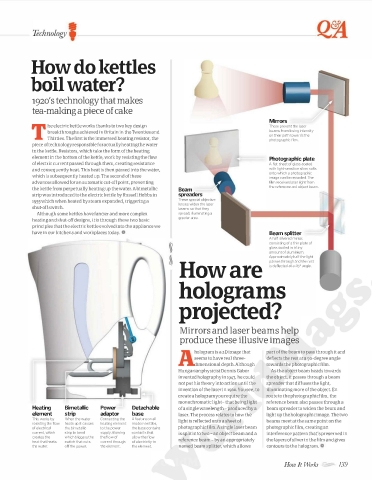
Mirrors
he electric kettle works thanks to two key design These prevent the laser
breakthroughs achieved in Britain in the Twenties and beams from losing intensity
on their path towards the
T Thirties. The first is the immersed heating resistor, the photographic film.
piece of technology responsible for actually heating the water
in the kettle. Resistors, which take the form of the heating
element in the bottom of the kettle, work by resisting the flow Photographic plate
of electric current passed through them, creating resistance A flat sheet of glass coated
and consequently heat. This heat is then passed into the water, with light-sensitive silver salts
onto which a photographic
which is subsequently heated up. The second of these image can be recorded. The
advances allowed for an automatic cut -off point, preventing film receives laser light from
the kettle from perpetually heating up the water. A bimetallic Beam the reference and object beam.
strip was introduced to the electric kettle by Russell Hobbs in spreaders
1955 which when heated by steam expanded, triggering a These special objective
lenses widen the laser
shut-off switch. beams so that they
Although some kettles have fancier and more complex spread, illuminating a
heating and shut-off designs, itis through these two basic greater area.
principles that the electric kettle evolved into the appliance we
have in our kitchens and workplaces today. 0 Beam splitter
A half-silvered mirror,
consisting of a thin plate of
� glass coated in a tiny
amount of aluminium.
Approximately half the light
passes through and the rest
How are is deflected at a 45° angle.
&
holograms
projected?
Mirrors and laser beams help
produce these illusive images
ologram is a zD image that part of the beam to pass through it and
eems to have real three deflects the rest at a 90-degree angle
imensional depth. Although towards the photographic film.
Hungarian physicist Dennis Gabor As the object beam heads towards
invented holography in 1947, he could the object, it passes through a beam
not put his theory into action until the spreader that diffuses the light,
invention of the laser in 1960. You see, to illuminating more of the object. En
create a hologram you require the route to the photographic film, the
monochromatic light- that being light reference beam also passes through a
Heating Bimetallic Power Detachable of a single wavelength -produced by a beam spreader to widen the beam and
element strip adaptor base laser. The process relates to how the light up the holographic image. The two
This works by When the water Connecting the A feature on all
resisting the flow heats up it causes heating element modern kettles, light is reflected onto a sheet of beams meet at the same point on the
of electrical the bimetallic to the power the base contains photographic film. A single laser beam photographic film, creating an
current, which strip to bend supply allowing contacts that is split into two -an object beam and a interference pattern that's preserved in
creates the which triggers the the flow of allow the flow
heat that heats switch that cuts current through of electricity to reference beam -by an appropriately the layers of silver in the film and gives
the water. off the power. the element. the element. named beam splitter, which allows contours to the hologram. 0
WorldMags.net How It Works 139
WorldMags.net

