


Page 22 - How It Works - Book of Amazing Answers To Curious Questions, 12
P. 22
AMAZIG ANSWERS TO CURIOUS QUESTIONS -------------------


        What does the liver do?


         The human liver is the ultimate multitasker -it performs many
         different functions all at the same time without you even asking


              he liver is the largest internal organ in   source. It is also responsible for breaking down   the rest of the body to use or excrete. The liver
              the human body and has over 500   complex fat molecules and building them up into   also breaks down old blood cells, produces
         T  functions. In fact, it is the second most   cholesterol and triglycerides, which the body   antibodies to fight infection and recycles
         complex organ after the brain and is involved in   needs but in excess are bad.   hormones such as adrenaline. Numerous
         almost every aspect of the body's metabolic   The liver rna kes many complex proteins,   essential vitamins and minerals are stored in the
         processes. Its main functions are energy   including clotting factors which are vital in   liver: vitamins A, D, E and K, iron and copper.
         production, removal of harmful substances and   arresting bleeding. Bile, which helps digest fat in   Such a complex organ is also unfortunately
         the production of proteins. These tasks are carried   the intestines, is produced in the liver and stored   prone to diseases. Cancers !most often metastatic
         out within liver cells called hepatocytes, which sit   in the adjacent gallbladder.   from other sources), infections !hepatitis) and
         in complex arrangements to maximise efficiency.   The liver also plays a key role in detoxifying   cirrhosis Ia form of fibrosis often caused by
          The liver is the body's main powerhouse,   the blood. Waste products, toxins and drugs are   excess alcohol consumption) are just some of
         producing and storing glucose as a key energy   processed here into forms which are easier for   those which can affect the liver. 0

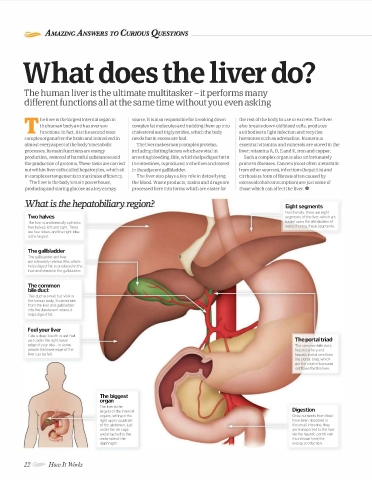
         What is the hepaliar regi                                                          Eight segments
                                                                                            Functionally, there are eight
          Two halves                                                                        segments of the liver, which are
          The liver is anatomically split into                                              based upon the distribution of
          two halves: left and right. There                                                 veins draining these segments.
          are four lobes, and the right lobe
          is the largest.

          The gallbladder
          The gallbladder and liver
          are intimately related. Bile, which
          helps digest fat. is produced in the
          liver and stored in the gallbladder.

          The common
          bile duct
          This duct is small. but vital in
          the human body. It carries bile
          from the liver and gallbladder
          into the duodenum where it
          helps digest fat.

          Feel your liver
          Take a deep  breath  in and feel
          just under the right lower                                                           The portal triad
          edge of your ribs - in some                                                          The common bile duct,
          people the lower edge of the                                                         hepatic artery and
          liver can be felt.                                                                   hepatic portal vein form
                                                                                               the  portal  triad, which
                                                                                               are the vital inflows and


                                 The biggest
                                 organ
                                 The liver is the
                                 largest of the internal                                       Digestion
                                 organs, sitting in the                                        Once  nutrients from food
                                 right upper quadrant                                          have been absorbed  in
                                 of the abdomen, just                                          the small intestine, they
                                 under the rib cage                                            are transported to the liver
                                 and attached to the                                           via the hepatic portal vein
                                 underside of the                                              (not shown here) for
                                 diaphragm.                                                    energy production.

         22     How It  TtOrks                  WorldMags.net
                                                WorldMags.net

