


Page 23 - How It Works - Book of Amazing Answers To Curious Questions, 12
P. 23
Science*------------------Q�


                                                                             Why is the

                                                                             liver a 'high

                                                                             demand'
                                                                             organ?


                                                                                  he liver deals with a massive amount of
                                                                                  blood. It is unique because it has two blood
                                                                             T  supplies. 75 per cent of this comes directly
                                                                             from the intestines !via the hepatic portal vein)
                                                                             which carries nutrients from digestion, which the
                                                                             liver processes and turns into energy. The rest
                                                                             comes from the heart, via the hepatic artery
                                                                             !which branches from the aorta), carrying oxygen
                                                                             that the liver needs to produce this energy. The
                                                                             blood flows in tiny passages in between the liver
                                                                             cells where the many metabolic functions occur.
                                                                             The blood then leaves the liver via the hepatic
                                                                             veins to flow into the biggest vein in the body- the
                                                                             inferior vena cava. 0
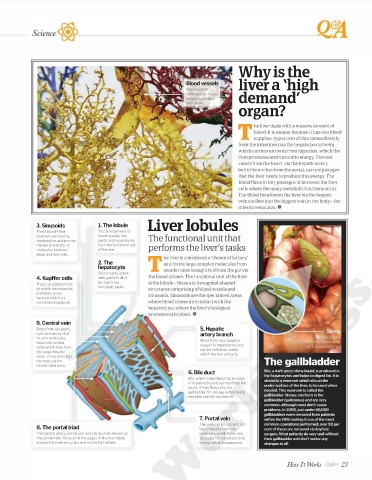
                                                Liver lobules
             3. Sinusoids       1. The lobule
             These blood-filled   This arrangement of
             channels are lined by   blood vessels, bile   The functional unit that
             hepatocytes and provide   ducts and hepatocytes
             the site of transfer of   form the functional unit   performs the liver's tasks
             molecules between   of the liver.
             blood and liver cells.
                                                     he liver is considered a 'chemical factory;
                                2. The               as it forms large complex molecules from
                                hepatocyte
                                These highly active   T  smaller ones brought to it from the gut via
             4. Kupffer cells   cells perform all of   the blood stream. The functional unit of the liver
                                the  liver's key   is the lobule - these are hexagonal-shaped
             These specialised cells
             sit within the sinusoids   metabolic tasks.   structures comprising of blood vessels and
             and destroy any
             bacteria which are                 sinusoids. Sinusoids are the specialised areas
             contaminating blood.               where blood comes into contact with the
                                                 hepatocytes, where the liver's biological
                                                processes take place. 0
             9. Central vein
             Blood from sinusoids,                               5. Hepatic
             now containing all of                               artery branch
             its new molecules,
             flows into central                                  Blood from here supplies
             veins which then flow                               oxygen to hepatocytes and
                                                                 carries metabolic waste
             into larger hepatic                                 which the liver extracts.
             veins. These drain into
             the heart via the
             inferior vena cava.
                                                             6. Bile duct
                                                             Bile, which helps digest fat, is made
                                                             in hepatocytes and secreted into bile
                                                             ducts. It then flows into the
                                                             gallbladder for storage before being
                                                             secreted into the duodenum.
                                                                 7. Portal vein
                                                                 This vein carries nutrient-rich
             8. The portal triad                                 blood directly from the
             The hepatic artery, portal vein and bile duct are known as   intestines, which flows into
             the portal triad. These sit at the edges of the liver lobule   sinusoids for conversion into
             and are the main entry and exit routes for the liver.   energy within hepatocytes.


                                                WorldMags.net
                                                WorldMags.net                                How It T%rks     23

