


Page 176 - (DK Eyewitness) Travel Guide - Brittany
P. 176
174 BRIT T AN Y REGION B Y REGION
Exploring Concarneau
The “Blue Town”, as it is known, after the blue fishing nets
that were used in the early 20th century, has an important
historic heritage. The islet of Le Conq was in habited from the
10th century by monks from Landévennec, and the earliest
fortifications date from the 13th century. By the 14th century,
the island settlement had become the fourth-largest fortified
town in Brittany. Briefly occupied by the English, the town
returned to the duchy of Brittany in 1373, then, with the
marriage of Anne of Brittany and Charles VIII, king of France,
in 1491, it became a royal town. Vauban reinforced its
defences in the 18th century. The first fish cannery opened in
1851, and 50 years later there were about 30 canning factories in
Concarneau. The disappearance of sardine stocks led to hardship
from 1905, but the Fête des Filets Bleus helped to raise funds for
families in difficulties. Today, the sixth-largest fishing port in
France, Concarneau produces 10,000 tonnes of fresh fish a year.
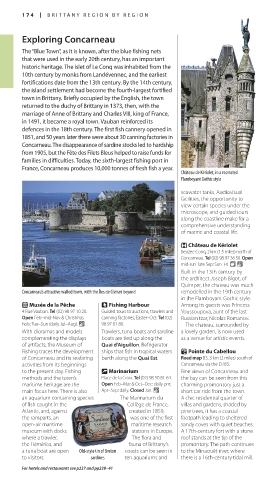
Château de Kériolet, in a recreated
Flamboyant Gothic style
seawater tanks. Audiovisual
facilities, the oppor tunity to
view certain species under the
microscope, and guided tours
along the coastline make for a
compre hensive understanding
of marine and coastal life.
+ Château de Kériolet
Beuzec-Conq, 2 km (1.5 miles) north of
Concarneau. Tel (02) 98 97 36 50. Open
mid-Jun–late Sep: Sun–Fri. 8 &
Built in the 13th century by
the architect Joseph Bigot, of
Quimper, the chateau was much
Concarneau’s attractive walled town, with the Îles de Glénan beyond remodelled in the 19th century
in the Flamboyant Gothic style.
E Musée de la Pêche D Fishing Harbour Among its guests was Princess
4 Rue Vauban. Tel (02) 98 97 10 20. Guided tours to auctions, trawlers and Youssoupova, aunt of the last
Open Feb–mid-Nov & Christmas canning factories, Easter–Oct: Tel (02) Russian tzar, Nicolas Romanov.
hols: Tue–Sun (daily Jul–Aug). & 98 97 01 80. The chateau, surrounded by
With dioramas and models Trawlers, tuna boats and sardine a lovely garden, is now used
complementing the displays boats are tied up along the as a venue for artistic events.
of artifacts, the Museum of Quai d’Aiguillon. Refrigerator
Fishing traces the develop ment ships that fish in tropical waters } Pointe du Cabellou
of Concarneau and its seafaring berth along the Quai Est. Road map B3. 3 km (2 miles) south of
activities from its beginnings Concarneau via the D783.
to the present day. Fishing Marinarium Fine views of Concarneau and
methods and the town’s Place de la Croix. Tel (02) 98 50 81 64. the bay can be seen from this
maritime heritage are the Open Feb–Mar & Oct–Dec: daily pm; charming promontory just a
main focus here. There is also Apr–Sep: daily. Closed Jan. & short car ride from the town.
an aquarium containing species The Marinarium du A chic residential quarter of
of fish caught in the Collège de France, villas and gardens, shaded by
Atlantic, and, against created in 1859, pine trees, it has a coastal
the ramparts, an was one of the first footpath leading to sheltered
open-air maritime maritime research sandy coves with quiet beaches.
museum with docks stations in Europe. A 17th-century fort with a stone
where a trawler, The flora and roof stands at the tip of the
the Hémérica, and fauna of Brittany’s promontory. The path continues
a tuna boat are open Old-style tin of Breton coasts can be seen in to the Minaouët river, where
to visitors. sardines ten aquariums and there is a 16th-century tidal mill.
For hotels and restaurants see p227 and pp239–41
174-175_EW_Brittany.indd 174 11/3/16 1:06 PM

