


Page 172 - (DK Eyewitness) Travel Guide - Brittany
P. 172
170 BRIT T AN Y REGION B Y REGION
Quimper Faience
The history of Quimper faience began in 1690, when Jean-Baptiste Bousquet settled in
the Locmaria district of the town. He came from Moustiers, in Provence, but competition
and the lack of wood to fire the kilns had forced him to seek his fortune elsewhere. In
Cornouaille, forests were more plentiful and royal permission to cut firewood easier to
obtain. Clay in the area was also abundant, and the Odet river provided a convenient means
of transport. Bousquet’s Manufacture de Pipes et Fayences soon prospered, and, thanks to
his granddaughter’s marriage, he benefited from Italian influence brought by a potter from
Nevers, a leading centre of faience manufacture. He was then joined by a manufacturer
from Rouen, another prestigious centre of faience production. In the 19th century, Alfred
Beau, a photo grapher and amateur painter from Morlaix, created a new style, based on
colourful scenes of daily life.
History of Faience
Faience was first made in southern
France and in Italy. Faience made in
Nevers, in central France, features
scenes of daily life and shows a
predominant use of yellow. Faience
made in Rouen, a major and distinctive
centre of production, is remarkably
colourful and displays a variety of
elaborate motifs, including flowers,
trees, birds and cornu copiae. In the
19th century, faience production was
dominated by the influence of Alfred
Beau and by the distinctive Quimper
style, with scenes of daily life depicted
in bright colours by the “single stroke”
technique, by which shape was defined
and colour applied by a single touch
of the brush.
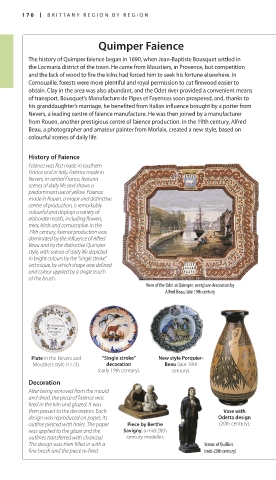
View of the Odet at Quimper, overglaze decoration by
Alfred Beau, late 19th century
Plate in the Nevers and “Single stroke” New style Porquier-
Moustiers style (1773). decoration Beau (late 19th
(early 19th century). century).
Decoration
After being removed from the mould
and dried, the piece of faience was
fired in the kiln and glazed. It was
then passed to the decorators. Each Vase with
design was reproduced on paper, its Odetta design
outline pierced with holes. The paper Piece by Berthe (20th century).
was applied to the glaze and the Savigny, a mid-20th
outlines transferred with charcoal. century modeller.
The design was then filled in with a Statue of Quillivic
fine brush and the piece re-fired. (mid-20th century)
170-171_EW_Brittany.indd 170 11/3/16 1:03 PM

