


Page 212 - (DK Eyewitness) Travel Guide - Brittany
P. 212
210 BRIT T AN Y REGION B Y REGION
7 Nantes
Historic capital of the dukes of Brittany, Nantes is today
capital of the Pays de la Loire. Such dual importance enhances
the cultural diversity of this vibrant city. Connected to the
Atlantic via the wide lower reaches of the Loire, Nantes
is a port city, and historically the slave trade ensured its
prosperity. But, in the heart of vegetable-growing country,
Nantes is now focused on a land-based economy. A stately
city but also a modern metropolis, an industrial and cultural
centre with a well-respected university, Nantes is one of the
most dynamic towns in France, with a steadily growing
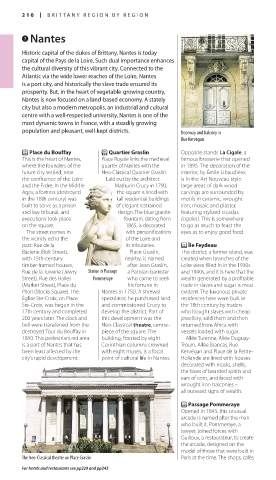
population and pleasant, well-kept districts. Doorway and balcony in
Rue Kervégan
P Place du Bouffay P Quartier Graslin Opposite stands La Cigale, a
This is the heart of Nantes, Place Royale links the medieval famous brasserie that opened
where the founders of the quarter of Nantes with the in 1895. The decoration of the
future city settled, near Neo-Classical Quartier Graslin. interior, by Émile Libaudière,
the confluence of the Loire Laid out by the architect is in the Art Nouveau style:
and the Erdre. In the Middle Mathurin Crucy in 1790, large areas of dark wood
Ages, a fortress (destroyed the square is lined with carvings are surrounded by
in the 18th century) was tall residential buildings motifs in ceramic, wrought
built to serve as a prison of elegant restrained iron, mosaic and plaster,
and law tribunal, and design. The blue granite featuring stylized cicadas
executions took place fountain, dating from (cigales). This is somewhere
on the square. 1865, is decorated to go as much to feast the
The street names in with personifications eyes as to enjoy good food.
the vicinity echo the of the Loire and
past: Rue de la its tributaries. P Île Feydeau
Bâclerie (Bolt Street), Place Graslin, This district, a former island, was
with 15th-century nearby, is named created when branches of the
timber-framed houses, after Jean Graslin, Loire were filled in in the 1930s
Rue de la Juiverie (Jewry Statue in Passage a Parisian barrister and 1940s, and it is here that the
Street), Rue des Halles Pommeraye who came to seek wealth gene rated by a profitable
(Market Street), Place du his fortune in trade in slaves and sugar is most
Pilori (Stocks Square). The Nantes in 1750. A shrewd evident. The luxurious private
Église Ste-Croix, on Place speculator, he purchased land residences here were built in
Ste-Croix, was begun in the and commissioned Crucy to the 18th century by traders
17th century and completed develop the district. Part of who bought slaves with cheap
200 years later. The clock and this development was the jewellery, sold them and then
bell were transferred from the Neo-Classical theatre, centre- returned from Africa with
destroyed Tour du Bouffay in piece of the square. The vessels loaded with sugar.
1860. This pedestrianized area building, fronted by eight Allée Turenne, Allée Duguay-
is a part of Nantes that has Corinthian columns crowned Trouin, Allée Brancas, Rue
been least affected by the with eight muses, is a focal Kervégan and Place de la Petite-
city’s rapid development. point of cultural life in Nantes. Hollande are lined with houses
decorated with masks, shells,
the faces of bearded spirits and
ears of corn, and faced with
wrought-iron balconies –
all outward signs of wealth.
P Passage Pommeraye
Opened in 1843, this unusual
arcade is named after the man
who built it. Pommeraye, a
lawyer, joined forces with
Guilloux, a restaurateur, to create
the arcade, designed on the
model of those that were built in
The Neo-Classical theatre on Place Graslin Paris at the time. The shops, cafés
For hotels and restaurants see pp229 and pp243
210-211_EW_Brittany.indd 210 11/3/16 1:03 PM

