


Page 214 - (DK Eyewitness) Travel Guide - Brittany
P. 214
212 BRIT T AN Y REGION B Y REGION
Around the Chateau and Beyond
The Château des Ducs de Bretagne (see pp214–15), with
Place du Bouffay and the Cathédrale St-Pierre-et-St-Paul,
once formed the hub of Nantes. This nucleus is on the
eastern side of the present city. The Jardin des Plantes,
the Musée d’Arts and the picturesque Lieu Unique are
other landmarks. The Musée Jules-Verne, devoted to this
famous native of Nantes, is on the western side of the
city, well beyond the port.
remains of the 13th-century
ramparts. Impasse St-Laurent,
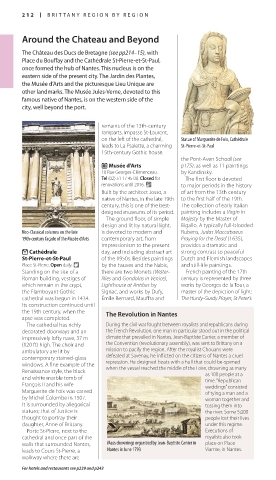
on the left of the cathedral, Statue of Marguerite de Foix, Cathédrale
leads to La Psalette, a charming St-Pierre-et-St-Paul
15th-century Gothic house.
the Pont-Aven School (see
E Musée d’Arts p175), as well as 11 paintings
10 Rue Georges-Clémenceau. by Kandinsky.
Tel (02) 51 17 45 00. Closed for The first floor is devoted
renovations until 2016. & to major periods in the history
Built by the architect Josso, a of art from the 13th century
native of Nantes, in the late 19th to the first half of the 19th.
century, this is one of the best- The collection of early Italian
designed museums of its period. painting includes a Virgin in
The ground floor, of simple Majesty by the Master of
design and lit by natural light, Bigallo. A typically full-blooded
Neo-Classical columns on the late is devoted to modern and Rubens, Judas Maccabaeus
19th-century façade of the Musée d’Arts contemporary art, from Praying for the Dead (1635),
Impressionism to the present provides a dramatic and
R Cathédrale day, and including abstract art strong contrast to peaceful
St-Pierre-et-St-Paul of the 1950s. Besides paintings Dutch and Flemish landscapes
Place St-Pierre. Open daily. 8 by the Fauves and the Nabis, and still-life paintings.
Standing on the site of a there are two Monets (Water- French painting of the 17th
Roman building, vestiges of lilies and Gondolas in Venice), century is represented by three
which remain in the crypt, Lighthouse at Antibes by works by Georges de la Tour, a
the Flamboyant Gothic Signac, and works by Dufy, master of the depiction of light:
cathedral was begun in 1434. Émile Bernard, Mauffra and The Hurdy-Gurdy Player, St Peter’s
Its construction continued until
the 19th century, when the The Revolution in Nantes
apse was completed.
The cathedral has richly During the civil war fought between royalists and republicans during
decorated doorways and an the French Revolution, one man in particular stood out in the political
impressively lofty nave, 37 m climate that prevailed in Nantes. Jean-Baptiste Carrier, a member of
(120 ft) high. The choir and the Convention (revolutionary assembly), was sent to Brittany on a
ambulatory are lit by mission to pacify the region. After the royalist Chouans were
contemporary stained-glass defeated at Savenay, he inflicted on the citizens of Nantes a cruel
windows. A fine example of the repression. He designed boats with a hull that could be opened
when the vessel reached the middle of the Loire, drowning as many
Renaissance style, the black as 100 people at a
and white marble tomb of time. “Republican
François II and his wife weddings” consisted
Marguerite de Foix was carved of tying a man and a
by Michel Colombe in 1507. woman together and
It is surrounded by allegorical tossing them into
statues; that of Justice is the river. Some 5,000
thought to portray their people lost their lives
daughter, Anne of Brittany. under this regime.
Porte St-Pierre, next to the Executions of
cathedral and once part of the royalists also took
walls that surrounded Nantes, Mass drownings organized by Jean-Baptiste Carrier in place on Place
leads to Cours St-Pierre, a Nantes in June 1793 Viarme, in Nantes.
walkway where there are
For hotels and restaurants see p229 and p243
212-213_EW_Brittany.indd 212 11/3/16 1:06 PM

