


Page 66 - (DK Eyewitness) Travel Guide - Brittany
P. 66
64 BRIT T AN Y REGION B Y REGION
Exploring Rennes
Despite the fire that devastated the city centre in 1720,
Rennes still has some fine medieval houses. It also has
many delightful mansions and a remarkable 17th-century
palace. The city has stood at a strategic crossroads since
Roman times. In the 10th century, it withstood Norman
invaders and became a symbol of Breton resistance. In the
15th century, new fortifications were built to strengthen the
existing Gallo-Roman ramparts. When Brittany became part
of France in 1532 and the parliament of Brittany was created
(see pp66–7), Rennes became the regional capital. After the
fire of 1720, a Neo-Classical city centre with rigidly straight
streets was built. This layout, and the buildings dating from the
same period, give Rennes a somewhat austere appearance.
A university town, Rennes has a conspicuously lively
population of students.
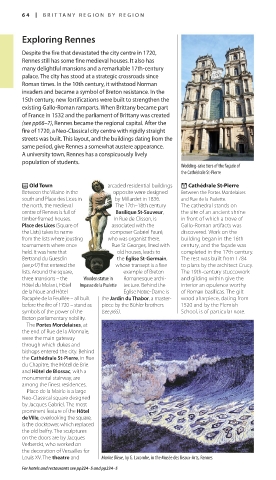
Wedding-cake tiers of the façade of
the Cathédrale St-Pierre
P Old Town arcaded residential buildings R Cathédrale St-Pierre
Between the Vilaine in the oppo site were designed Between the Portes Mordelaises
south and Place des Lices in by Millardet in 1836. and Rue de la Psalette.
the north, the medieval The 17th–18th century The cathedral stands on
centre of Rennes is full of Basilique St-Sauveur, the site of an ancient shrine
timber-framed houses. in Rue de Clisson, is in front of which a trove of
Place des Lices (Square of associated with the Gallo-Roman artifacts was
the Lists) takes its name composer Gabriel Fauré, discovered. Work on the
from the lists where jousting who was organist there. building began in the 16th
tourna ments where once Rue St-Georges, lined with century, and the façade was
held. It was here that old houses, leads to completed in the 17th century.
Bertrand du Guesclin the Église St-Germain, The rest was built from 1784
(see p47) first entered the whose transept is a fine to plans by the architect Crucy.
lists. Around the square, example of Breton The 19th-century stuccowork
three mansions – the Wooden statue in Romanesque archi- and gilding within give the
Hôtel du Molant, Hôtel Impasse de la Psalette tecture. Behind the interior an opulence worthy PLACE ST-MALO
de la Noue and Hôtel Église Notre-Dame is of Roman basilicas. The gilt HOCHE
Racapée de la Feuillée – all built the Jardin du Thabor, a master- wood altarpiece, dating from Ste-Anne R UE S T-MEL AI NE
before the fire of 1720 – stand as piece by the Bühler brothers 1520 and by the Flemish PLACE St-Melaine
symbols of the power of the (see p65). School, is of particular note. RU E ST-LOUIS STE-ANNE
Ste-Anne
Breton parliamentary nobility. R U E HOCHE COURS DE LAMOTTE Jardin du
PLACE
The Portes Mordelaises, at ST-MICHEL R UE L E BASTARD RUE DES FOSSÉS Thabor
PLACE
the end of Rue de la Monnaie, DES LICES RUE MA R T E N O T
were the main gateway Parlement
du Bretagne
RUE
through which dukes and TOULOUSE NATIONALE R UE V I CTOR - H U GO
RUE DE
RUE DE LA MONNAIE
bishops entered the city. Behind Portes PLACE DU
PALAIS
the Cathédrale St-Pierre, in Rue Mordelaises Basilique Theatre R
du Chapitre, the Hôtel de Brie St-Sauveur Hôtel PLACE R. ED ITH CAVEL L Église
DE LA
de Ville
and Hôtel de Blossac, with a Cathédrale Hotel de Blossac MAIRIE RUE ST-GEORGES U E GAM BETTA
St-Germain
St-Pierre
monumen tal stairway, are R UE S T- Y V E S RUE D'ORLEANS R U E K LEB E R
among the finest residences. PL MAL RUE DE ROHAN
FOCH
Place de la Mairie is a large Q UAI D U GU AY T ROU IN Q U A I L AMAR T IN E QU A I C HATE AU B R IAN D
La Vilaine
PLACE DE LA
Neo-Classical square designed QU A I LA M E N N AI S RÉPUBLIQUE Q U A I É MI LE-ZOLA
République
by Jacques Gabriel. The most PLACE DE R UE D E LA CH A LO TAIS R UE D U P RE -B O T T E Musée des LE MANS
prominent feature of the Hôtel BRETAGNE Beaux-Arts
de Ville, overlooking the square, Aéroport AVENUE JEAN-JANVIER
7 km (4 miles)
is the clocktower, which replaced R U E P O ULL A IN -DU PA RC RUE DE NEMOURS RUE VA S S E LOT
the old belfry. The sculptures NANTES BOULEVARD DE LA LIBERTÉ RUE DU MARECHAL JOFFRE RUE ST-THOMAS
on the doors are by Jacques
Verberckt, who worked on Écomusée de BOULEVARD DE LA LIBERTÉ Gare Routière,
Gare SNCF
the decoration of Versailles for la Bintinais 300 m (330 yards)
Louis XV. The theatre and Marine Bleue, by G. Lacombe, in the Musée des Beaux-Arts, Rennes
For hotels and restaurants see pp224–5 and pp234–5
064-065_EW_Brittany.indd 64 11/3/16 12:42 PM

